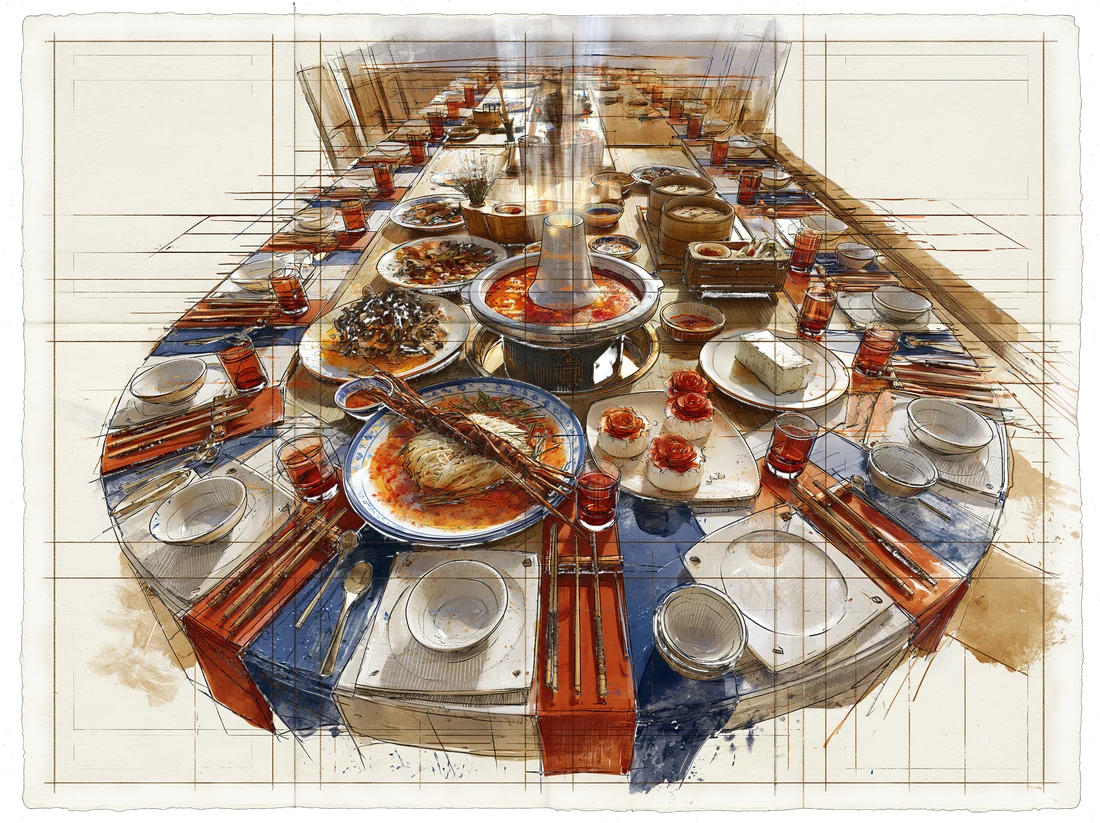
Yunnan food is not Sichuan-spicy. Let me say that twice because the assumption is so common: Yunnan food is not Sichuan-spicy. The province is adjacent to Sichuan, and Sichuan-style restaurants exist in Yunnan cities, but the indigenous Yunnan cuisine tradition is its own thing — sour, herbal, mushroom-forward, regional, and far less famous globally than it deserves to be.
Here's what you'll likely encounter.
The thesis
Yunnan cuisine is shaped by three forces:
- Altitude and climate — cold mountain weather favors warming foods (clay pots, stews, fermented preserves) and discourages the year-round chilies that define Sichuan
- Ethnic minority influences — Bai goat cheese, Naxi dairy, Tibetan yak butter, Dai sour-sweet from the southern border — all blend into a province-wide pattern of "use what your neighbor grows"
- Wild ingredients — Yunnan is the most botanically diverse province in China, and its cuisine takes that seriously: foraged mushrooms, wild herbs, mountain vegetables you've never seen in Beijing
The result is a cuisine that's richer in non-pungent flavor than most Han-Chinese regional cooking. Sour, herbal, umami-forward — yes. Spicy — sometimes, but not by default.
The headline dishes
A working list, with characters for menu-pointing. You won't eat all of these, but you'll likely encounter most.
Cross-bridge rice noodles 过桥米线
The dish that put Yunnan on the Chinese culinary map. A boiling clay pot of chicken broth arrives at the table, followed by sliced raw meat, vegetables, herbs, and a separate bowl of rice noodles. You assemble it yourself — the broth is hot enough to cook the meat in 30 seconds. Originated, by legend, in Mengzi in southeastern Yunnan: a scholar's wife brought him hot meals while he studied on an island, and the layer of oil on top kept the broth scalding across the bridge.
It is the most famous Yunnan dish. You'll have a chance to try it on Day 1 or Day 5.
Wild mushroom hotpot 野生菌火锅
Yunnan is home to the majority of China's edible mushroom species — sources put the share anywhere from two-thirds to over 90% depending on how you count. The signature local hotpot is a clear, herbal broth simmered with whatever's in season — porcini, chanterelle, ji zong 鸡枞, the prized 见手青 ("see-hand-blue") Boletus species, and a dozen others. June is early season; the real mushroom obsession peaks July–September.
Bai clay-pot fish 砂锅鱼
The Day 1 dinner candidate. Local fish from Erhai Lake (often crucian carp or a relative) is simmered in a clay pot with mountain herbs, tofu, mushrooms, and a light sour-tomato base. A Bai signature.
Bai raw pork 生皮
A Bai specialty for the adventurous. Thinly-sliced lean pork, served raw, dressed with chili oil, herbs, vinegar, and lime. It's a serious Bai cultural marker — and a non-trivial food-safety question for those who don't eat raw pork. Opt in only if you're comfortable; opt out without apology if you're not. See dietary realities for the broader rules.
Naxi baba 纳西粑粑
Pan-fried flatbread, ~6cm thick, made from wheat or rice flour. Comes in two main styles: savory (with herbs and pork fat) or sweet (with brown sugar). Eaten as a breakfast or snack item, often with butter tea. Likely on Day 4 or Day 5.
Three-Course Tea 三道茶
Bai ceremonial tea, served in three sequential pours: bitter green, sweet (with walnut and brown sugar), and "lingering" (with Sichuan peppercorn, ginger, and honey). See the Bai section for the cultural context. Probable on Day 1 evening.
Erkuai 饵块
Pressed rice cake — rice steamed, pounded, and shaped into a dense cake that's sliced and grilled, fried, or stir-fried with eggs and pickled mustard greens. Common breakfast in Yunnan cities; you may see it as a street snack in Dali or Lijiang.
Rubing 乳饼
Bai goat cheese. Unusual in China — Han cuisine famously eschews dairy — but the Bai picked it up via Tea Horse Road contact with Tibetan and Mongolian traditions. Pan-fried in slices, sometimes drizzled with honey or chili. Genuinely delicious; usually a side dish.
Chicken-bean jelly 鸡豆凉粉
A Lijiang specialty — a cold, savory bean jelly tossed with chili oil, vinegar, garlic, and green onion. Refreshing on a hot Lijiang afternoon. Vegetarian-friendly.
Drinks worth trying
- Yunnan tea: Pu'er 普洱 (aged, dark, distinctive), Dianhong 滇红 (Yunnan black tea), and high-mountain green teas
- Plum wine 梅子酒: locally fermented, sometimes house-made — sweet, low-alcohol
- Coffee — yes, really. Yunnan is China's largest coffee-growing region, and small-batch local roasters exist in Dali and Lijiang. Worth seeking out if you miss real coffee in Beijing.
A character cheat sheet
Save these for menu-pointing — Chinese restaurants in rural Yunnan often have Mandarin-only menus, sometimes with handwritten daily specials.
| Dish | Characters | Pronunciation |
|---|---|---|
| Cross-bridge rice noodles | 过桥米线 | guò qiáo mǐ xiàn |
| Wild mushroom hotpot | 野生菌火锅 | yě shēng jūn huǒ guō |
| Clay-pot fish | 砂锅鱼 | shā guō yú |
| Naxi baba | 纳西粑粑 | nà xī bā ba |
| Three-Course Tea | 三道茶 | sān dào chá |
| Erkuai | 饵块 | ěr kuài |
| Bai cheese | 乳饼 | rǔ bǐng |
| Chicken-bean jelly | 鸡豆凉粉 | jī dòu liáng fěn |
| No spice | 不要辣 | bú yào là |
| I'm allergic to ___ | 我对___过敏 | wǒ duì ___ guò mǐn |
The richest cuisine in China that almost nobody outside China knows.
If you go in expecting Sichuan, you'll be confused. Go in expecting the other Yunnan — sour, herbal, mushroom-forward — and your taste calibration will be right.
For the practical reality of group-meal logistics in rural locations, see the dietary section.