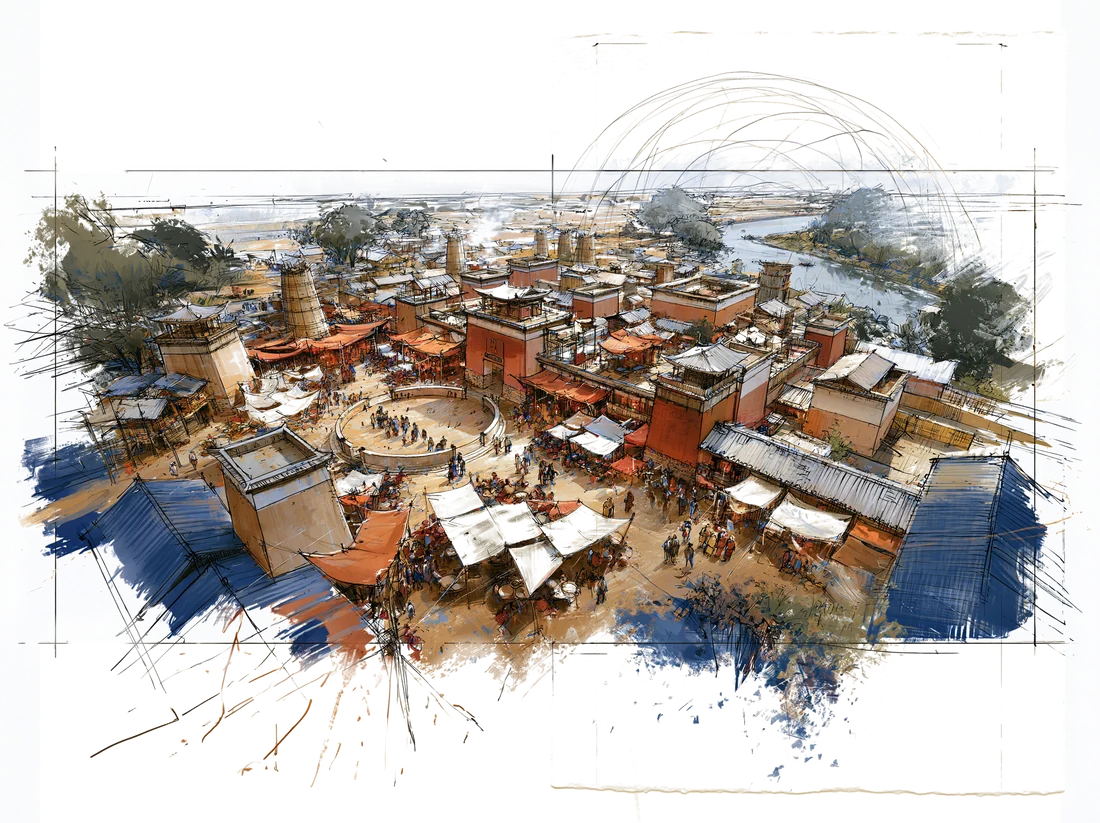
Shaxi 沙溪 is the trip's hinge — geographically and thematically. You arrive from Dali (Bai-country), you leave for Lijiang (Naxi-country), and in between you stand in the only intact Tea Horse Road marketplace that survived into the 21st century. The Friday Market on Day 4 morning is the cultural climax of the whole trip.
Here's why.
Why Shaxi survived
Most Tea Horse Road waystations didn't. As the road declined in the 20th century — replaced first by the Burma Road, then by highways — the caravan-era infrastructure was either modernized away or torn down for new construction. Shaxi escaped both fates for a single reason: it was remote enough that nobody bothered.
The 2001 inclusion of Shaxi's Sideng Square 寺登街 on the World Monuments Fund "100 Most Endangered Sites" watch list triggered a Sino-Swiss rehabilitation project led by ETH Zürich and the Jianchuan County government, beginning in 2002. The project's working principle: restore the physical infrastructure without sterilizing the living community. By most accounts they succeeded.
Sideng Square
The square itself is small — perhaps 60 meters across — but every building around it has a function in the Tea Horse Road economy:
- The Xingjiao Temple 兴教寺 (Ming dynasty, 1415) on the west — the spiritual anchor, where caravans prayed for safe passage
- The opera stage facing the temple — for festival days and travelers' entertainment
- The caravan inns ringing the square on the north and south — three-story timber buildings with mule yards at ground level
- The public well in the center — communal water for both residents and traveling muleteers
Walk the perimeter. The buildings haven't moved in 500 years. It is the only intact Tea Horse Road marketplace, frozen mid-function.
The Friday Market
Now the marquee event of Day 4.
Every Friday morning, farmers, herders, and traders from the surrounding mountain villages — Bai, Yi, Lisu, and a few Tibetan vendors from the higher elevations — descend on Sideng Square for a working market. It is not staged for tourists. It is the actual commerce of rural northwest Yunnan.
What you'll see:
- Livestock — live chickens, ducks, pigs, sometimes sheep, in caged pens, being sold for real money to real farmers
- Dried mushrooms by the kilo — Yunnan is China's mushroom heartland and June is early season for the prized 见手青 Boletus-family species
- Mountain herbs: tianqi 三七, jujube, gentian, dried orchid root — much of it harvested in the surrounding mountains the week before
- Hand-loomed textiles: hemp bags, indigo-dyed cottons, the occasional embroidered shoulder bag
- Fresh produce: small mountain potatoes, garlic, wild greens, foraged fruit
- Tea bricks — yes, still
What to look for, what to skip
A soft scavenger list for Day 4:
- Find a vendor selling rice noodles 米线 made that morning — a different product from the dried kind
- Look for rubing 乳饼 (Bai goat cheese) — usually pressed into 200g rounds, wrapped in waxed paper
- Try to spot a tea brick vendor — there are usually two or three, often selling Pu'er from 50–500g compressions
- See if you can find handwoven indigo — distinguishable by the slight color variation in the dye batch
- Skip anything that looks pre-packaged for tourists — small souvenir-grade items at fixed prices are not the real market
Photography ethics
This is real working life. Adjust accordingly.
- Ask before photographing people, especially elderly vendors. Even a small head-nod is enough — they'll tell you yes or no.
- Don't photograph livestock transactions in close-up. The animals aren't happy and the moment isn't a photo op.
- Don't haggle aggressively at the market if you don't plan to buy. Cheap performance bargaining burns goodwill that future visitors pay for.
See the broader rules in etiquette.
What's next
After the market, you'll have lunch and pile into a private car for the four-hour drive north to Lijiang. The pivot from Bai-world (Dali, Shaxi) to Naxi-world (Lijiang, Shuhe) happens on that drive.
If the Friday Market is the climax of the trip, the bus ride is the transition. Look out the window.