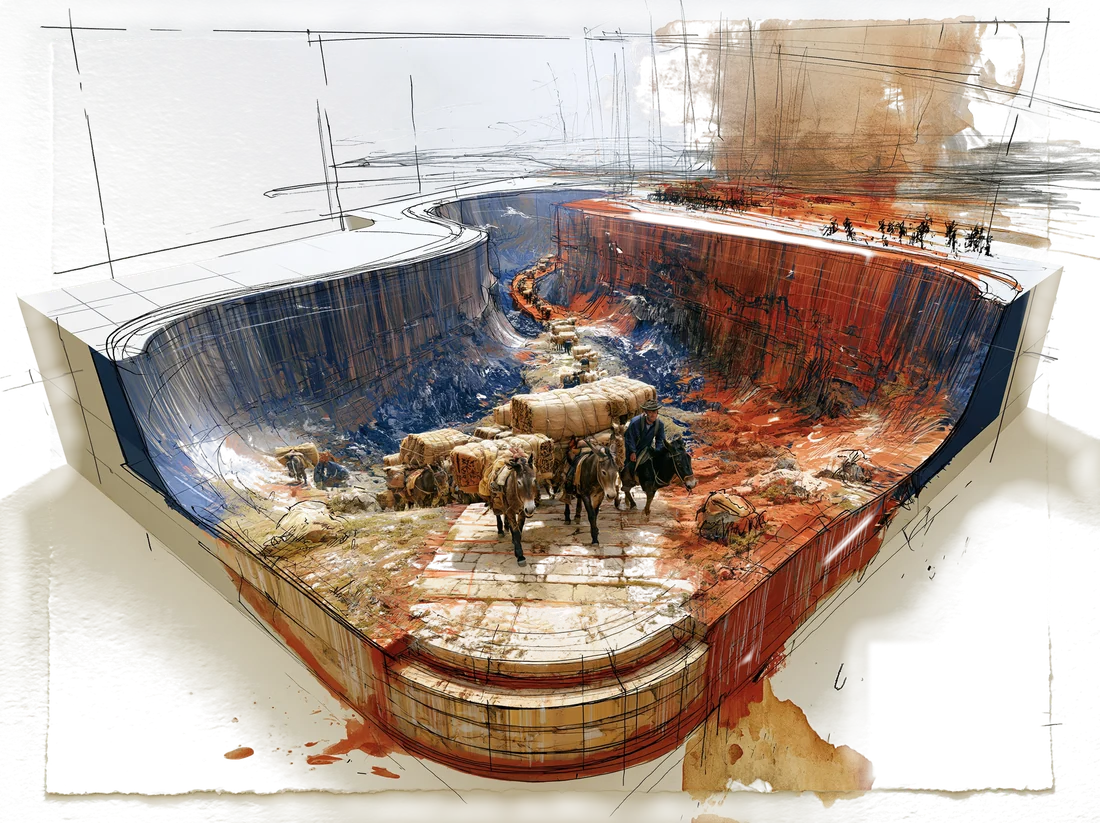
For at least 1,500 years — possibly far longer — the Tea Horse Road 茶马古道 was the artery that stitched together a region the imperial Chinese map never quite knew what to do with. Tea moved north. Horses moved south. Salt, silk, copper, and silver moved along the same routes. And the cultures the road touched were not, by and large, conquered — they were traded with.
That is the through-line of this trip.
What it actually was
The Tea Horse Road wasn't one road. It was a network of overlapping mule-trail routes connecting Yunnan and Sichuan to Tibet, and onward into India, Nepal, Bhutan, and Burma. Two major arteries dominated:
- The Yunnan route — starting in Pu'er or Xishuangbanna in the south, threading north through Dali, Lijiang, Shangri-La, and on into Tibet
- The Sichuan route — from Ya'an across the Tibetan Plateau
The Yunnan route is the one our trip retraces. Dali → Shaxi → Lijiang is the road's middle stretch, and Shaxi was historically a major waystation for caravans heading north.
What was traded
The names tell you the headline:
- Tea brick (compressed Pu'er-style tea) moved north. Tibetan diet — heavy on yak, butter, and tsampa — created enormous demand for the polyphenols, vitamins, and tannins in fermented tea. A tea brick was, for centuries, also a unit of currency.
- Tibetan horses moved south. The Chinese imperial armies, especially the Tang and Song, needed cavalry mounts bred for endurance over speed. Tibetan-stock horses fit the bill.
But the road carried more than those two: salt from the Yunnan brine wells, silver from local mines, silk and porcelain from the lowland trade economy, herbal medicine and yak butter from the highlands, and — increasingly into the 18th and 19th centuries — opium.
Who actually walked it
Not, mostly, Han Chinese imperial agents. The road was walked by Naxi, Bai, and Tibetan muleteers — small family-operated caravans of 10–30 mules, each loaded with 60–80kg, covering 20–30km a day in dry weather and far less in monsoon.
A round trip from Pu'er to Lhasa took six months to a year. Some muleteers spent their entire adult lives on the road.
Why it preserved cultures rather than erasing them
This is the part the trip is really about.
Empire-led conquest tends to assimilate. The Tea Horse Road wasn't empire-led — it was trade-led, and trade rewards specialization. The Bai stayed Bai because Bai craftspeople produced things — silver, textiles, smoked goods — that the caravans valued. The Naxi stayed Naxi because Naxi merchant families owned the caravans crossing their territory. Each community had an economic role that was strengthened, not threatened, by participation in the network.
The road traded without conquering.
That's why, when you walk through Shaxi's Sideng Square on Day 4 or Lijiang Old Town on Day 5, the local cultural particularity hasn't been bleached out. The road operated for a thousand years without ever requiring it to be.
What survives today
The road as a working trade route ended in the mid-20th century — first because the Burma Road (1937) and then highway infrastructure made caravan travel obsolete, and then because the Cultural Revolution disrupted the social structures the trade depended on.
But the physical infrastructure survives:
- Shaxi's Sideng Square — the only intact Tea Horse Road marketplace, with the original temple-theater-inn cluster
- Lijiang Old Town — a UNESCO World Heritage Site, with a street grid that follows caravan flow rather than imperial Chinese square-grid logic
- Pu'er tea — still produced in roughly the form it was 500 years ago, with the same compression-and-aging method that made it a viable trade commodity
And the road has begun a kind of cultural revival: the UNESCO push for Shaxi in the early 2000s, a Yunnan tea-tourism boom, and a new generation of researchers documenting the surviving Naxi/Bai trading family histories.
This trip isn't a history tour, but if you have one image to carry with you: the road is the reason three towns 200km apart in 2026 still feel like three different worlds.