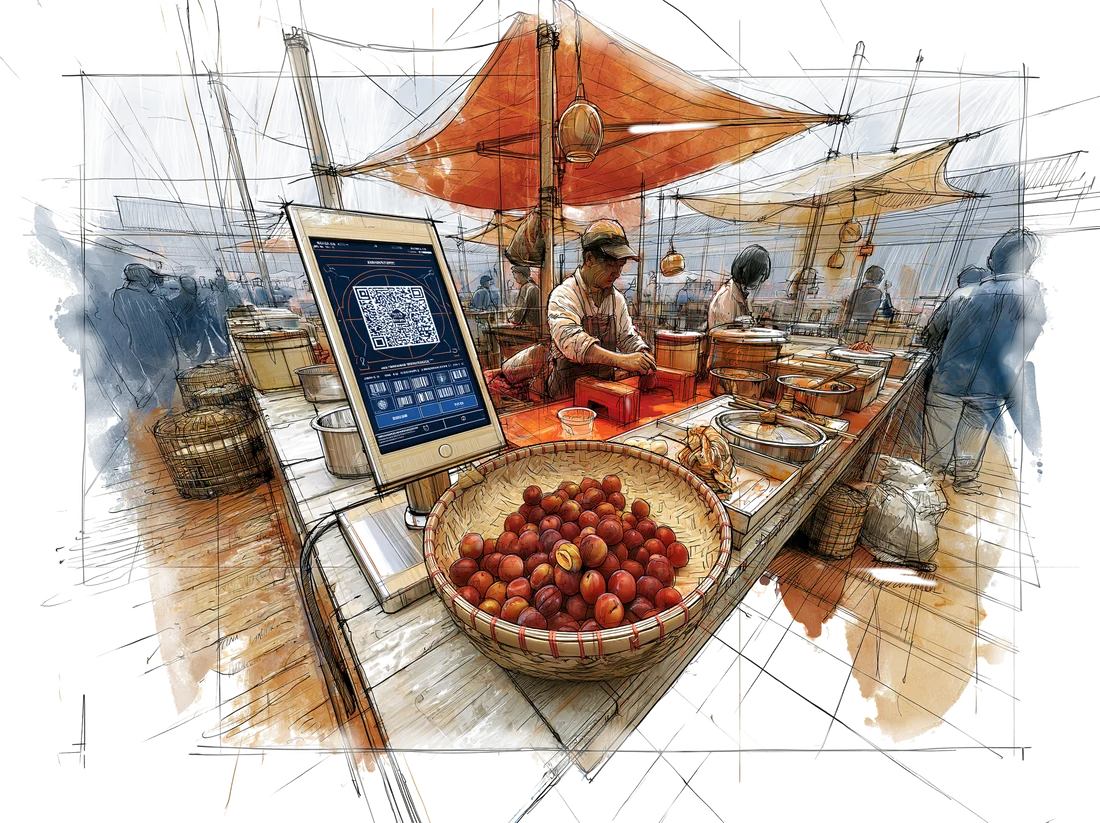
The good news: this is a domestic-China trip, so most scholars already have the payment + connectivity stack figured out. The not-quite-so-good news: there are some Yunnan-specific gotchas. Here's the briefing.
Payments
WeChat Pay 微信支付 and Alipay 支付宝 are universal. Universal:
- Restaurants in Dali Old Town
- Vendors at the Shaxi Friday Market
- Tiny rural farmers selling vegetables on the street
- Taxis, DiDi rides, parking lots, vending machines, public toilets (sometimes)
Cash is a backup, not a primary payment method.
The foreign-card gotcha
If you're a non-Chinese scholar relying on a foreign credit/debit card linked to WeChat Pay or Alipay (both now allow this), test it in Beijing before departure:
- Pay for something small (a coffee, a metro top-up)
- Confirm the transaction goes through cleanly
- If you get an "additional verification" prompt, do the verification while you have Beijing-quality connectivity
Foreign-card transactions sometimes trigger re-verification that requires SMS + identity steps. You don't want to be standing at a Shaxi market stall trying to verify your card while three vendors are waiting.
Cash backup
Bring ¥300–500 in small bills (¥10, ¥20, ¥50). For:
- Tipping a local guide if you have one (rare, but small gestures are appreciated)
- Backup if your phone dies and you can't pay digitally
- Small market purchases where digital payment feels awkward (rare in 2026, but still happens at the smallest vendors)
- Hot drinks and snacks in transit on the Day 3 / Day 4 private car rides
ATMs are easy in Dali and Lijiang. Shaxi has at least one ATM but don't count on it.
Tipping
Not customary. Don't tip at restaurants. Don't tip taxi drivers. You can tip a local guide ¥50–100 at the end of a day if they really went above and beyond, but it's a gift, not an expectation. If you tip and the recipient declines, accept the decline gracefully — that's the cultural script. See etiquette for the broader pattern.
The Great Firewall
For non-Chinese scholars who haven't been here long: Google, Instagram, WhatsApp, Gmail, Facebook, YouTube, Twitter/X are all blocked.
If you've been in Beijing for months, you already have a VPN setup. Yunnan doesn't change anything — the same VPN that works in Beijing will work in Dali. Just confirm it's installed and tested before you fly out.
Apps that do work in China (no VPN needed):
- WeChat (微信) — the operating system
- Alipay (支付宝) — payments
- DiDi (滴滴) — ride-hail; the international version works
- Amap 高德地图 — maps
- Pleco — Mandarin dictionary, free with paid upgrades
Maps
Amap 高德地图 (literally "Gaode Maps") is the local favorite, and it works well in northwest Yunnan. The English UI is partial but functional. The international version is in the App Store; the full Chinese version is more powerful but requires reading characters.
Baidu Maps works too; Apple Maps barely works in China; Google Maps doesn't work in China at all.
Critical: download offline regions for Shaxi in Amap before you leave Dali. Connectivity in Shaxi is patchy and you'll want offline navigation for the Old Town and the surrounding villages.
Ride-hail
DiDi 滴滴 is the dominant ride-hail. The international version (DiDi Rider) lets you pay with a foreign credit card and has English UI. Available in Dali, Lijiang, and most cities.
Shaxi is too small for DiDi — getting around there is by private car (already arranged for the trip) or by foot (which is fine; the town is walkable).
Translation
Pleco is the gold standard for Mandarin dictionary + OCR. Free with paid upgrades; the free version covers most needs. Use the camera OCR mode to point at menus, signs, or notes.
For real-time conversation translation, Baidu Translate and iFlytek 讯飞 are decent for short exchanges. Don't expect either to handle a long conversation.
Power
China uses a mix of plug types — Type A (same as US), Type C (European two-prong), and Type I (Australian three-prong). Most hotel rooms have a universal socket that accepts all three.
For US/Schwarzman scholars: your existing US-plug devices will plug straight in. Bring a small power strip if you have several devices; one socket per device adds up quickly in a hotel room.
A practical note
If you've never used WeChat Pay or Alipay, set it up in Beijing this week. Even Chinese scholars without much rural-China travel experience may want to top up the cash backup. The Friday Market is the one place where you may genuinely want small bills.