Guangdong · 5 min read广东 · 约 5 分钟
Guangzhou and Cantonese culture广州与广府文化
Two thousand years as China's southern port: Shamian, the Chen Clan Ancestral Hall, Yuexiu Hill, qilou arcades, and the ritual of morning tea.做了两千年的南方口岸:沙面、陈家祠、越秀山、骑楼,还有一盅两件的早茶。
Guangzhou is the city the West long called Canton, and for most of its history it has been the place where China met the sea. It sits at the head of the Pearl River Delta, upriver from Hong Kong, and today it's a megacity of glass towers, metro lines, and wholesale markets. Under the skyscrapers is an older city of ancestral halls, arcaded shopping streets, and teahouses, and a language, Cantonese, that carried its culture around the world.
Two thousand years as a port
The city's story starts with a breakaway kingdom. In 204 BC a former Qin general, Zhao Tuo, founded the kingdom of Nanyue (南越) with its capital at Panyu, today's Guangzhou. It lasted 93 years and five rulers before Emperor Wu of Han conquered it in 111 BC. The tomb of the second king, Zhao Mo, was found in the middle of the city and is now the Nanyue King Museum, whose star is a burial suit of jade plates sewn together with silk thread.
From then on, ships from Southeast Asia, India, and the Arab world came up the Pearl River. Guangzhou's great moment came under the Qing. From 1757 to 1842, under what Westerners called the Canton System (一口通商, "trade through a single port"), all European and American trade with China was legally confined to Guangzhou. Foreign merchants lived and worked in the Thirteen Factories (十三行), a strip of warehouses and offices on the riverbank outside the city walls, and could only deal through a licensed guild of Chinese merchants, the Cohong. Tea, silk, and porcelain went out; silver, and increasingly opium, came in. The First Opium War ended the system, and the Treaty of Nanking in 1842 opened four more ports.
Shamian Island
After the Second Opium War, the British and French were given a sandbank in the river, Shamian (沙面), as concessions in 1859. Britain took three fifths, France two fifths. The island is small, about 900 m long and 300 m wide, and still lined with banyan trees and the stone mansions of trading houses, banks, and consulates, with deep verandahs built for the climate. Britain gave up its concession in 1943 and France in 1946. Today it's a protected historic district and the city's most relaxed place for a walk.
The Cantonese world
Cantonese (粤语) is spoken by roughly 80 million people. It has six tones to Mandarin's four, and the Guangzhou variety is the standard one, the reference pronunciation for broadcasting. You'll hear it everywhere, though nearly everyone also speaks Mandarin.
The regional style is called Lingnan (岭南), "south of the ridges," after the mountains that cut Guangdong off from the rest of China. It shows up in architecture, painting, gardens, and food: open, airy buildings with courtyards and carved screens, and a cuisine built on freshness.
What to see
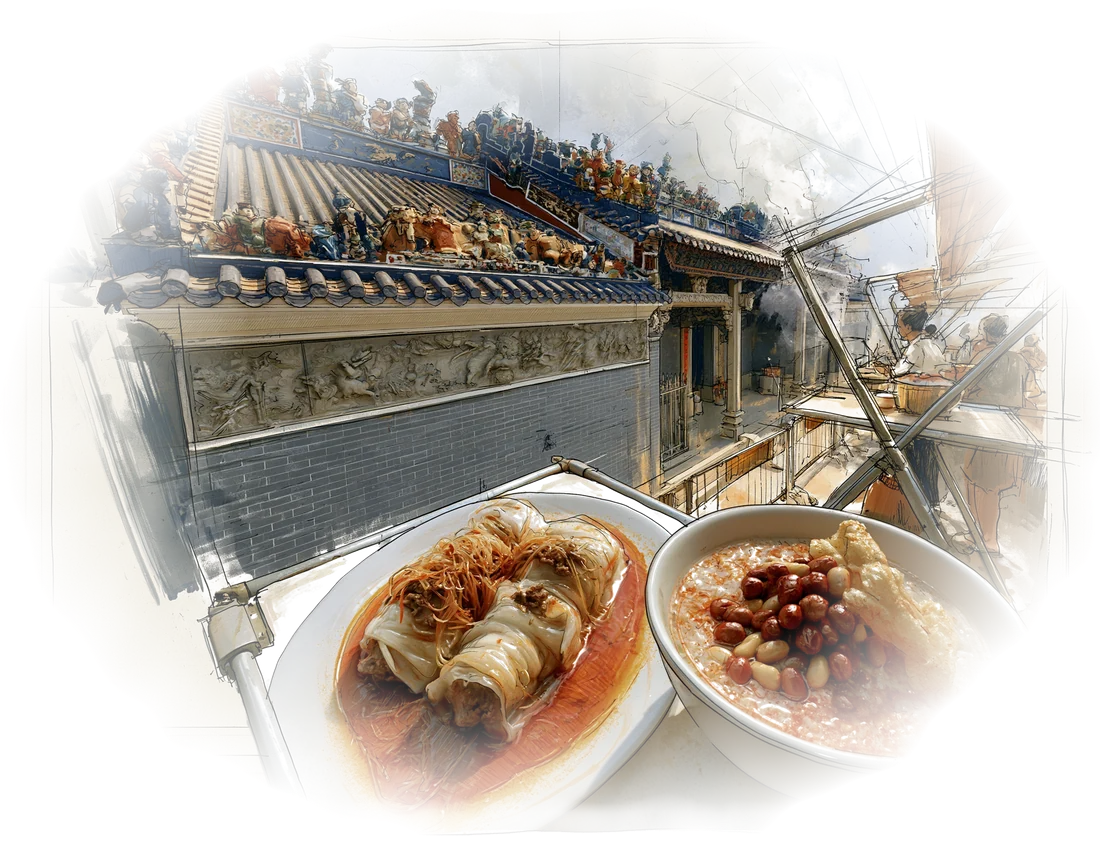
- Chen Clan Ancestral Hall (陈家祠). Built in 1894, paid for by Chen clans from 72 counties across Guangdong as an academy where young men from the clan could prepare for the imperial exams. It covers 13,200 square meters, with 19 buildings, nine halls, and six courtyards. The real show is the decoration: wood, stone, and brick carving, plaster sculpture, cast iron, and ceramic ridge figures. The biggest ridge runs 27 m and carries 224 figures. It's now the Guangdong Folk Arts Museum.
- Yuexiu Hill and Zhenhai Tower (镇海楼). The big park in the old city center. On top stands the Zhenhai Tower, "Tower Guarding the Sea," a five-story, 28 m red tower built in 1380 in the early Ming, once the tallest building in Guangzhou. It now houses the Guangzhou Museum. Also in the park is the Five Rams statue, a nod to the legend that gave Guangzhou the nickname "City of Rams."
- Qilou arcades (骑楼). Guangzhou's characteristic shophouses: shops on the ground floor, homes above, and the upper floors pushed out over the sidewalk on pillars to make a covered arcade against sun and rain. Most were built in the 1930s, before the war with Japan. The best are in the old Xiguan (西关) district: Shangxiajiu pedestrian street, and Enning Road (恩宁路), the city's longest and best-preserved arcade street, with Bruce Lee's ancestral home and the Bahe Guild Hall of Cantonese opera. Beijing Road, where glass panels in the pavement show layer upon layer of excavated road surfaces from earlier dynasties, is the other classic shopping street.
- Canton Tower (广州塔). The slender, twisted TV tower on the south bank of the Pearl River, across from the Zhujiang New Town skyline. Best after dark, when it and the riverbanks light up.
Morning tea and the eating city
The full yum cha spread is steamed shrimp dumplings (har gow), pork siu mai, barbecued pork buns, rice-noodle rolls, chicken feet, and egg tarts, ordered off a checklist and eaten slowly over pots of tea. Teahouses fill early, especially on weekends and holidays, and a morning tea can easily slide into lunch. More on Cantonese food, including roast goose and wonton noodles, is in Eating the southern coast.
How the city feels
Guangzhou is two cities side by side. The old core, Liwan and Yuexiu, is dense, low, and full of street life. The new east, Tianhe, around Taikoo Hui and Zhujiang New Town, is malls, offices, and wide boulevards. The metro ties it together, and from Guangzhou it runs on into Shunde. The days here are Day 1, Day 2, and the morning of Day 3.
For a century, if you wanted China's tea, you came to Canton. The city still does business first and asks questions later.
Sources
广州就是西方人长期叫作 Canton 的那座城,在它的大部分历史里,中国就是在这里跟大海打交道的。它坐落在珠江三角洲的顶端,在香港上游,如今是一座玻璃幕墙、地铁线路和批发市场铺满的超大城市。可在摩天楼底下,还藏着另一座老城:宗祠、骑楼商街、茶楼,还有一种把广府文化带到全世界的语言,粤语。
做了两千年的港口
故事要从一个割据王国说起。公元前 204 年,原秦朝将领赵佗建立南越国,定都番禺,也就是今天的广州。南越国传了五代、历时 93 年,公元前 111 年被汉武帝攻灭。第二代南越王赵眜的陵墓就在市中心被发现,如今是南越王博物院,镇馆之宝是一件用丝线把玉片缀连起来的丝缕玉衣。
此后,来自东南亚、印度和阿拉伯世界的船只一直沿珠江驶来。广州最风光的时候是在清代。1757 年到 1842 年,西方人称之为“广州体制”的一口通商,把欧美对华贸易全部限定在广州一地。外商只能在城墙外江边一排商馆里居住和办公,这就是十三行;买卖也只能通过官府特许的中国商人行会,也就是公行来做。茶叶、丝绸、瓷器从这里运出去,白银,以及越来越多的鸦片,从这里运进来。第一次鸦片战争终结了这套体制,1842 年的《南京条约》又开放了另外四个口岸。
沙面
第二次鸦片战争之后,江中一块沙洲沙面于 1859 年被划为英法租界,英国占五分之三,法国占五分之二。岛不大,东西约 900 米、南北约 300 米,至今仍是榕树成荫,沿江排开洋行、银行和领事馆的石砌洋楼,带着为适应岭南气候而修的深深外廊。英国 1943 年放弃租界,法国 1946 年放弃。如今这里是受保护的历史街区,也是全城最适合慢慢散步的地方。
粤语的世界
粤语大约有 8,000 万使用者。普通话四个声调,粤语有六个,广州话是标准音,广播电视都以它为准。在广州到处都能听到粤语,不过几乎人人也都会说普通话。
这一带的地域风格叫岭南,“五岭以南”,得名于把广东和中原隔开的那一列山。岭南风格体现在建筑、绘画、园林和饮食里:通透敞亮、带天井和雕花隔扇的房子,讲究一个“鲜”字的菜。
看什么
- 陈家祠。 建于 1894 年,由广东 72 个县的陈氏宗亲集资兴建,是供族中子弟备考科举的书院。占地 13,200 平方米,共 19 座建筑,九堂六院。真正的看点在装饰:木雕、石雕、砖雕、灰塑、铁铸,还有屋脊上的陶塑,最大的一条屋脊长 27 米,上面有 224 个人物。如今是广东民间工艺博物馆。
- 越秀山与镇海楼。 老城中心的大公园。山顶的镇海楼是一座五层、高 28 米的红楼,建于明初 1380 年,曾是广州最高的建筑,现在是广州博物馆。公园里还有五羊石像,对应着广州“羊城”这个别名的传说。
- 骑楼。 广州最有代表性的街屋:底层开铺,楼上住人,楼上部分用柱子撑出来盖住人行道,形成一条遮阳挡雨的长廊。大多建于抗战前的 1930 年代。最好看的在老西关:上下九步行街,和全城最长、保存最完整的骑楼街恩宁路,李小龙祖居和粤剧行会八和会馆都在这条街上。另一条经典商业街是北京路,路面上的玻璃窗下能看到考古发掘出的层层叠叠的历代古道。
- 广州塔。 珠江南岸那座纤细扭腰的电视塔,“小蛮腰”,正对珠江新城的天际线。天黑以后最好看,塔和两岸一起亮起来。
早茶与吃的城市
完整的早茶阵容是虾饺、烧卖、叉烧包、肠粉、凤爪、蛋挞,在点心纸上勾选,一盅茶配着慢慢吃。茶楼一早就满,周末和节假日更甚,一顿早茶吃着吃着就到了午饭点。烧鹅、云吞面这些广府味道,详见沿着海岸吃一路。
这座城的气质
广州其实是两座城并排而立。老城荔湾、越秀,密、矮,满是市井烟火;新城天河,太古汇和珠江新城一带,是商场、写字楼和宽马路。地铁把它们串在一起,还一路通到顺德。在广州的日子是第 1 天、第 2 天和第 3 天上午。
整整一个世纪,想要中国的茶,就得来广州。这座城至今还是先做生意,再问别的。
参考资料
Where this shows up on the trip行程里对应的日子