Practicalities · 5 min read实用信息 · 约 5 分钟
Eating the southern coast沿着海岸吃一路
Four kitchens in one week: Cantonese dim sum and roast meats, Shunde's fish and milk, Teochew braises and beef, Minnan noodles and oyster omelets.一周四种菜系:广府的点心烧味、顺德的鱼和奶、潮州的卤水和牛肉、闽南的面线糊和海蛎煎。
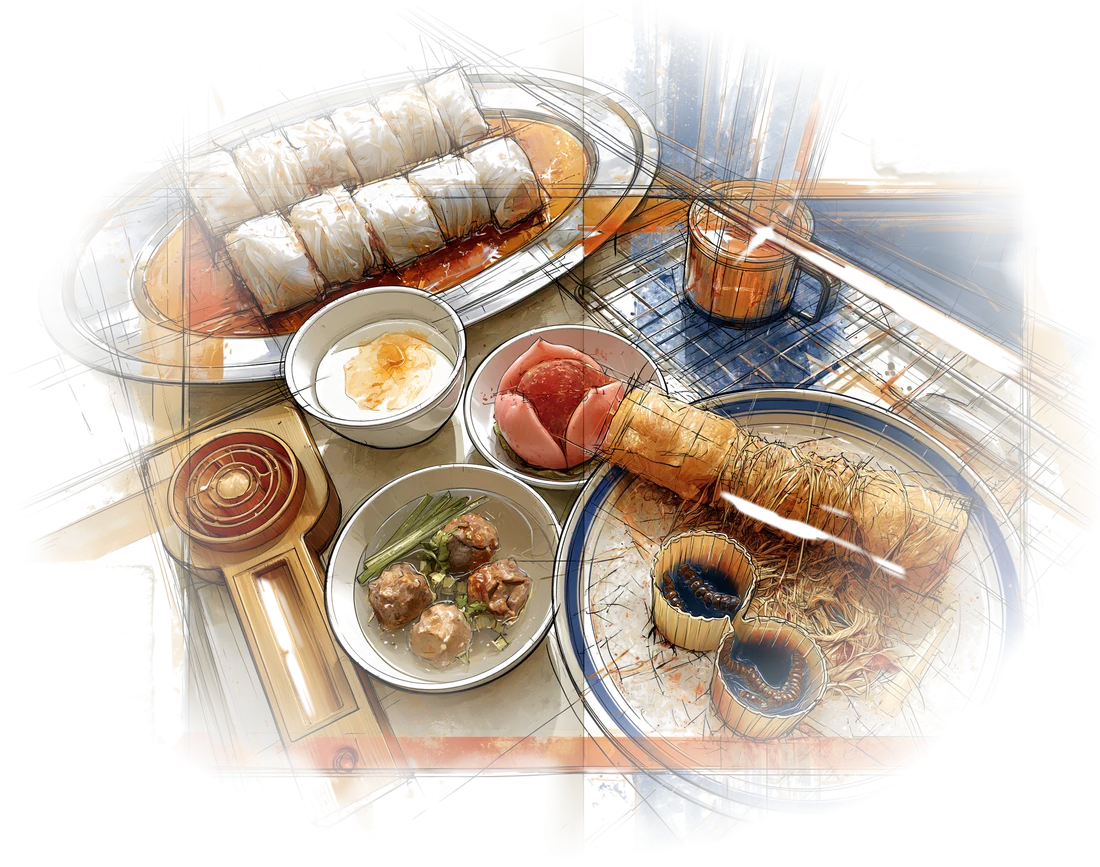
This trip runs through four distinct kitchens in eight days. They share a coastline, a love of seafood, and an obsession with freshness, but they are not one cuisine. Guangzhou cooks Cantonese food at its most polished. Shunde, next door, is the cradle of Cantonese chefs. Chaozhou cooks Teochew food, lighter and more austere, with its own dialect and its own tea. Quanzhou belongs to Minnan, the southern Fujian tradition of noodles, oysters, and ginger. This page leans toward what each city eats on the street, at breakfast counters, snack stalls, and dessert shops, with a note on the sit-down dishes too. For a dish-by-dish list, see Eats.
Guangzhou: Cantonese at the source
"Eat in Guangzhou" is an old saying, and the city still takes it seriously. Cantonese cooking aims for balance: light seasoning, clean flavors, and ingredients that are cooked just enough. On the street that means breakfast and late nights. (More on the city in Guangzhou and Cantonese culture.)
- Cheung fun (肠粉). Rice-noodle rolls, the default Guangzhou breakfast. There are two schools. Cloth-steamed 布拉肠, the older Guangzhou style, spreads the batter on a cloth for a sheet so thin the filling is the point. Drawer-steamed 抽屉肠, the street-stall standard, is made from plain rice batter in stacked metal drawers that slide out, take batter and fillings, and slide back in for a minute; it is judged on the noodle and the sauce.
- Sampan congee (艇仔粥). Congee loaded with fish, shrimp, pork, peanuts, and fried dough, first sold by boat families on the Lizhiwan creeks of Liwan.
- Beef offal (牛杂). Tripe, lung, and intestine stewed for hours with white radish, fished out of the pot and eaten with chili sauce.
- Wonton noodles (云吞面). Thin, springy egg noodles and shrimp wontons in a clear broth.
- Dry-fried beef ho fun (干炒牛河). The late-night wok dish, made with flat rice noodles named after Shahe, now part of Tianhe.
- Bowl pudding (砵仔糕). A sweet rice cake steamed in little porcelain bowls and eaten off bamboo skewers.
Sit-down Guangzhou is yum cha, morning tea with har gow, siu mai, and char siu bao in the old-name teahouses, and siu mei, roast goose and char siu hanging in the window of the roast-meat shop. Tong sui (糖水), "sugar water," the family of sweet soups from red bean and black sesame to ginger milk curd, sits somewhere in between.
Shunde: fresh above all
Shunde, on Day 3 and Day 4, was named a UNESCO City of Gastronomy in 2014, the second in China after Chengdu. Its cooks are famous across the Cantonese world, and the local creed is simple: the ingredient must be as fresh as possible, and the cook's job is not to get in its way. Its snacks are named after its towns. (See Shunde: a city of gastronomy.)
- Double-skin milk (双皮奶). A buffalo-milk custard from Daliang, dating to the late Qing. The milk is heated and left to cool until a skin forms, then the milk is poured out from under that skin, sweetened with egg white and sugar, returned to the bowl, and steamed, so the finished custard wears two skins.
- Fried milk (炸牛奶). Milk custard cut into domino-sized blocks and deep-fried: crisp outside, soft inside. Its sit-down cousin is Daliang stir-fried milk (大良炒牛奶), buffalo milk and egg white softly set into white curds.
- Lunjiao cake (伦教糕). A translucent white cake of fermented rice batter and sugar, from the town of Lunjiao.
- Jun'an fish cakes (均安鱼饼). Snakehead fish beaten to a paste, pressed into thin patties, and pan-fried golden.
- Chencun rice noodles (陈村粉). Thin, soft rice-noodle sheets from the town of Chencun, steamed and dressed with soy and sesame.
- Fish sashimi (鱼生). Paper-thin slices of raw freshwater fish, tossed with shredded ginger, onion, peanuts, and peanut oil. Raw freshwater fish carries a real liver-fluke risk.
The big sit-down dish is Jun'an steamed pig (均安蒸猪), a whole marinated pig steamed for hours until the fat turns tender.
Chaozhou: Teochew restraint
Teochew food, on Day 5 and Day 6, relies on poaching, steaming, and braising, with less oil than most Chinese cooking and a different dipping sauce for nearly every dish. Its street food lives in the old town's lanes. (See Chaozhou: the Teochew old town.)
- Beef balls (牛肉丸). Beef pounded by hand into a paste, then shaped into balls that bounce, served in clear soup or fried with shacha sauce.
- Kueh (粿). A whole family of rice-flour dumplings and cakes, savory and sweet, pressed in carved wooden molds, steamed, and often fried. The pink, peach-shaped red peach kueh (红桃粿) is the emblem; rice-cudweed, bamboo-shoot, and chive kueh are the everyday ones.
- Oyster omelet (蚝烙). Small oysters fried crisp in a batter of sweet-potato starch and duck egg.
- Beef kway teow (牛肉粿条). Flat rice noodles in beef soup with beef balls, or stir-fried dry.
- Fermented bean curd pastry (腐乳饼). A flaky pastry with a sweet-savory filling of fermented bean curd, pork fat, sugar, and garlic.
- Duck-mother rice balls (鸭母捻). Big glutinous rice balls with bean or taro fillings in sweet syrup, bobbing in the bowl like a duck on the water.
- Gongfu tea (工夫茶). Strong oolong brewed in a tiny pot and poured into thimble-sized cups. Chaozhou gongfu tea became national intangible heritage in 2008 and is part of the UNESCO listing for Chinese tea traditions added in 2022.
At the table, Teochew cooking means braised goose (卤鹅) in a dark master stock, cold fish rice (鱼饭) (no rice involved), watery congee (糜) with salty pickles, and beef hotpot (牛肉火锅), freshly cut beef dipped for seconds.
Quanzhou: Minnan comfort
Quanzhou, on Day 7, eats more like Taiwan or Penang than like Guangzhou, and counts some 300 traditional snacks. (See Quanzhou: Emporium of the World.)
- Mianxian hu (面线糊). The classic breakfast: ultra-fine wheat noodles cooked into a smooth soup with a stock of pork bones and seafood, topped with fried dough, vinegared pork, or intestines.
- Sea-worm jelly (土笋冻). A cold, translucent jelly set from a small sea worm, eaten with soy, vinegar, and mustard. Anhai, in Jinjiang, is said to make the best, and outsiders tend to dare one another to try it.
- Oyster omelet (海蛎煎). The Minnan version of the Teochew dish: fat oysters, egg, garlic greens, and starch fried until crisp at the edges.
- Braised-pork rice dumpling (烧肉粽). Glutinous rice with mushroom, dried shrimp, chestnut, and braised pork, boiled in leaves. Quanzhou claims it as its own.
- Runbing (润饼). Fresh spring rolls in a paper-thin wrapper, filled with shredded vegetables, pork, oysters, seaweed, and crushed peanut.
- Shihua jelly and four-fruit soup (石花膏, 四果汤). A cooling seaweed jelly, a local snack for more than a century, shaved into a bowl with beans, lotus seeds, and fruit in syrup. It's a summer dessert, so it may be scarce in February.
The famous sit-down dish is ginger duck (姜母鸭), duck braised slowly in a clay pot with old ginger, sesame oil, and rice wine, a warming winter meal.
How to eat it
- Go early. Breakfast is the main event in all four cities, and the best stalls sell out by mid-morning.
- Order small and often. Street food comes by the bowl, the plate, or the skewer. Share one of everything and keep walking.
- Watch the pot. A busy stall with a quick turnover is the freshest one.
- Share at the table. Dishes go in the middle. Take the piece nearest you rather than picking through the plate.
- Accept the tea. At a Chaozhou table the host keeps refilling those tiny cups. Drink, tap, and keep the conversation going.
Four cities, four kitchens, one rule: the fresher the better.
Sources
- Cantonese cuisine (Wikipedia)
- Cheung fun (Wikipedia)
- The two schools of Guangdong cheung fun (NetEase, in Chinese)
- 艇仔粥 (Wikipedia, in Chinese)
- Shahe fen (Wikipedia)
- Shunde District (Wikipedia)
- A Bite of Shunde, city of gastronomy (Newsgd)
- Classic Shunde snacks (Foshan Bendibao, in Chinese)
- Teochew cuisine (Wikipedia)
- Chaoshan kueh varieties (Sina, in Chinese)
- Oyster omelette (Wikipedia)
- Customs and etiquette in Chinese dining (Wikipedia)
- Chaozhou gongfu tea and UNESCO listing (Yangcheng Evening News, in Chinese)
- Quanzhou local snacks (Quanzhou Municipal Government)
- Quanzhou's 300-plus traditional snacks (China News Service Fujian, in Chinese)
- Flavorful Origins (Wikipedia)
八天里,这趟旅行要穿过四个各成一派的厨房。它们共享一条海岸线,都爱海鲜,都对“鲜”有执念,但并不是同一种菜。广州做的是最讲究的广府菜;隔壁的顺德,是粤菜厨师的摇篮;潮州做潮汕菜,更清淡、更克制,有自己的方言,也有自己的茶;泉州则属于闽南,面线、海蛎和老姜撑起一桌。这一页偏重每座城街头的吃法:早餐档、小吃摊、糖水铺,也顺带说说坐下来吃的菜。按菜逐样整理的清单见吃喝。
广州:粤菜的源头
“食在广州”是老话,广州人至今当真。粤菜讲究平衡:调味清淡、味道干净,火候刚好断生。落到街头,就是早餐和宵夜两头。(城市背景见广州与广府文化。)
- 肠粉。 广州人的头号早餐,分两派。布拉肠是广州老派做法,米浆摊在布上蒸,皮薄得吃的全是馅;抽屉肠是街边档的标配,纯米浆,一层层不锈钢抽屉拉出来刷浆、撒料,推回去蒸一两分钟,讲究的是粉质和酱汁。
- 艇仔粥。 白粥里加鱼片、虾仁、瘦肉、花生、油条,当年是荔湾荔枝湾的水上人家撑着小艇卖的。
- 牛杂。 牛肚、牛肺、牛肠跟白萝卜一起炆几个钟,从锅里捞出来蘸辣椒酱吃。
- 云吞面。 细而爽口的竹升面,配鲜虾云吞和清汤。
- 干炒牛河。 宵夜的镬气担当,河粉的全名沙河粉,得名于如今属天河区的沙河。
- 砵仔糕。 小瓷砵蒸出来的甜米糕,插两根竹签拿着吃。
坐下来吃的广州,是老字号茶楼里的早茶(虾饺、烧卖、叉烧包),和烧腊档橱窗里挂着的烧味(烧鹅、叉烧)。糖水介于两者之间:红豆沙、芝麻糊、姜撞奶,各式甜汤甜品。
顺德:鲜字当头
顺德在第 3 天和第 4 天,2014 年被联合国教科文组织评为**“世界美食之都”**,是继成都之后中国第二个。顺德厨师名满粤菜圈,本地的信条很简单:食材越新鲜越好,厨师的本事是别去抢它的味道。顺德的小吃,多半以镇为名。(见顺德:世界美食之都。)
- 双皮奶。 出自大良,清代后期就有,用水牛奶。牛奶加热后放凉,结出一层奶皮,把奶皮下的牛奶倒出来,加蛋清和糖,倒回碗里隔水炖,做好的双皮奶便有了两层皮。
- 炸牛奶。 奶糊切成骨牌大小,挂糊油炸,外脆里软。它在饭桌上的堂兄是大良炒牛奶:水牛奶加蛋清,软炒成雪白的奶块。
- 伦教糕。 发酵米浆加白糖蒸成的晶莹白糕,出自伦教镇。
- 均安鱼饼。 生鱼肉打成鱼胶,压成薄饼,煎到金黄。
- 陈村粉。 陈村出的薄滑米粉,蒸热后淋豉油、撒芝麻。
- 鱼生。 薄如纸的生淡水鱼片,拌姜丝、洋葱、花生和熟油。生吃淡水鱼有感染肝吸虫的实际风险。
坐下来吃的大菜是均安蒸猪:整只腌好的猪上笼蒸几个小时,蒸到肥肉都酥软。
潮州:潮汕的克制
潮汕菜在第 5 天和第 6 天,靠的是白灼、清蒸和卤,用油比大多数中国菜少,几乎每道菜都配一款专属蘸料。街头小吃就在古城的巷子里。(见潮州:潮汕的老城。)
- 牛肉丸。 牛肉手工捶成肉浆再挤成丸,弹得能跳起来,清汤煮或炸了蘸沙茶酱。
- 粿。 一大家族的米粉点心,有咸有甜,用雕花木粿印压出形状,先蒸后煎。粉红色桃形的红桃粿是代表,鼠曲粿、笋粿、韭菜粿是家常款。
- 蚝烙。 小个的蚝仔裹上番薯粉浆和鸭蛋,煎到焦脆。
- 牛肉粿条。 宽米粉配牛肉片、牛肉丸煮汤,或者干炒。
- 腐乳饼。 酥皮里包腐乳、肥膘、糖、蒜头调的馅,咸甜交织。
- 鸭母捻。 大个的糯米汤圆,包绿豆、红豆或芋泥,泡在糖水里,像母鸭浮在水上。
- 工夫茶。 浓酽的乌龙茶,小壶冲泡,倒进顶针大小的茶杯。潮州工夫茶艺 2008 年列入国家级非物质文化遗产,2022 年作为“中国传统制茶技艺及其相关习俗”的一部分列入联合国教科文组织名录。
饭桌上的潮菜,则是老卤汤里卤透的卤鹅、放凉吃的鱼饭(其实一粒米都没有)、清得见米粒的白糜配杂咸,还有现切鲜牛肉、涮几秒就捞的牛肉火锅。
泉州:闽南的家常
泉州在第 7 天,吃起来更像台湾或槟城,而不像广州,传统小吃据说有三百来种。(见泉州:宋元中国的世界海洋商贸中心。)
- 面线糊。 泉州最经典的早餐:极细的面线和猪骨、海鲜熬的汤煮成糊,上面加油条、醋肉或大肠。
- 土笋冻。 用一种叫星虫的小海虫熬出胶质、冷却成冻,晶莹透亮,蘸酱油、醋和芥辣吃。以晋江安海的最出名,外地人常把它当成挑战胆量的“黑暗料理”。
- 海蛎煎。 闽南版的蚝烙:肥嫩的海蛎、鸡蛋、青蒜和地瓜粉,煎到边缘焦脆。
- 烧肉粽。 糯米加香菇、虾米、栗子、烧肉,粽叶包好煮熟。泉州认它是本地发明。
- 润饼。 薄如蝉翼的饼皮,卷上各式菜丝、猪肉、海蛎、海苔和花生末。
- 石花膏、四果汤。 石花草熬成的清凉冻,在泉州已有上百年历史,刨成细条,加豆子、莲子和水果,浇糖水。这是夏天的甜品,二月未必好找。
坐下来吃的名菜是姜母鸭:鸭肉加老姜、麻油和米酒,砂锅慢火煲透,冬天吃最暖。
怎么吃
- 早点去。 四座城都把早餐当头等大事,好吃的档口上午就卖完收摊。
- 少点多尝。 街头吃食按碗、按碟、按串卖。每样来一份分着吃,边走边吃。
- 看锅。 人多、翻台快的档口,东西最新鲜。
- 上桌就分着吃。 菜放在桌子中间,夹离自己最近的那块,别在盘里挑挑拣拣。
- 茶来就喝。 在潮州的茶桌上,主人会不停给小杯续茶。喝完、叩指,接着聊。
四座城,四个厨房,一条规矩:越鲜越好。
参考资料
- Cantonese cuisine(维基百科)
- Cheung fun(维基百科)
- 广东肠粉主要流派:布拉肠与抽屉式肠粉(网易)
- 艇仔粥(维基百科)
- Shahe fen(维基百科)
- Shunde District(维基百科)
- A Bite of Shunde, city of gastronomy(南方网英文版)
- 顺德有哪些经典的美食(佛山本地宝)
- Teochew cuisine(维基百科)
- 潮汕粿类这么多,数数看你吃过多少种(新浪)
- Oyster omelette(维基百科)
- Customs and etiquette in Chinese dining(维基百科)
- 广东再添“世界级”非遗 用非遗文化带动茶产业发展(羊城晚报)
- 特色小吃(泉州市人民政府)
- “五一”假期探营之泉州美食:300 余种特色小吃(中新网福建)
- Flavorful Origins(维基百科)
Where this shows up on the trip行程里对应的日子