Fujian · 5 min read福建 · 约 5 分钟
Quanzhou: Emporium of the World泉州:宋元中国的世界海洋商贸中心
A UNESCO World Heritage port of Song and Yuan China: Kaiyuan Temple, the Confucius temple, Qingjing Mosque, West Street, and Xunpu's hairpin flowers.世界遗产里的宋元海港:开元寺、府文庙、清净寺、西街,还有蟳埔女头上的簪花围。
Quanzhou is the quiet surprise at the end of this route. Today it is a prosperous, low-key city in southern Fujian, better known inside China for shoes, sportswear, and tea than for sightseeing. Seven or eight hundred years ago it was one of the busiest ports on earth, the place Arab and Persian merchants called Zayton, where ships from the Indian Ocean unloaded pepper, incense, and pearls and loaded silk and porcelain. Much of that medieval city is still standing, scattered through a red-brick old town that is easy to walk. We arrive by train on Day 7 and fly home from Quanzhou Jinjiang airport on Day 8.
A World Heritage port
In July 2021, at the 44th session of the World Heritage Committee held in Fuzhou, UNESCO inscribed "Quanzhou: Emporium of the World in Song-Yuan China." The listing is unusual: instead of one monument, it is a set of 22 component sites dating from the 10th to the 14th centuries, together telling the story of how a whole maritime economy worked. They include:
- The administration: the site of the Maritime Trade Office (Shibosi), set up here in 1087 to tax and regulate foreign shipping, and the site of the office that managed the Song imperial clan's southern branch.
- The city: the ruins of Deji Gate, the old south gate, and the roads, bridges, and docks that tied the walled city to the river and the sea.
- Faith: Buddhist, Taoist, Islamic, Confucian, and even Manichaean sites, plus temples to the sea goddess Mazu.
- Production and transport: kiln sites at Dehua and Cizao, where export porcelain was fired, an iron-smelting site in Anxi, and the bridges, piers, and pagodas that guided ships into the bay.
Zayton: Marco Polo and Ibn Battuta
The city's Arabic name, Zaytun, means "olive." It was probably a pun on its Chinese nickname, 刺桐城, the "Coral Tree City," after the coral trees planted along its walls in the 10th century. Under the Mongol Yuan dynasty, Zayton was China's great port to the west. Marco Polo sailed from here in the early 1290s and called it one of the two greatest havens for commerce in the world. A half-century later, in the 1340s, the Moroccan traveler Ibn Battuta landed at Zaytun and called it simply the greatest port in the world. Both men saw a cosmopolitan city with Muslim, Christian, Hindu, and Buddhist communities living side by side, and much of the evidence for that, in carved gravestones and temple fragments, survives in the city's museums.
The old town
Our hotel sits by the Confucius temple, at the heart of the old walled city. Most of the major sites are a walk away.
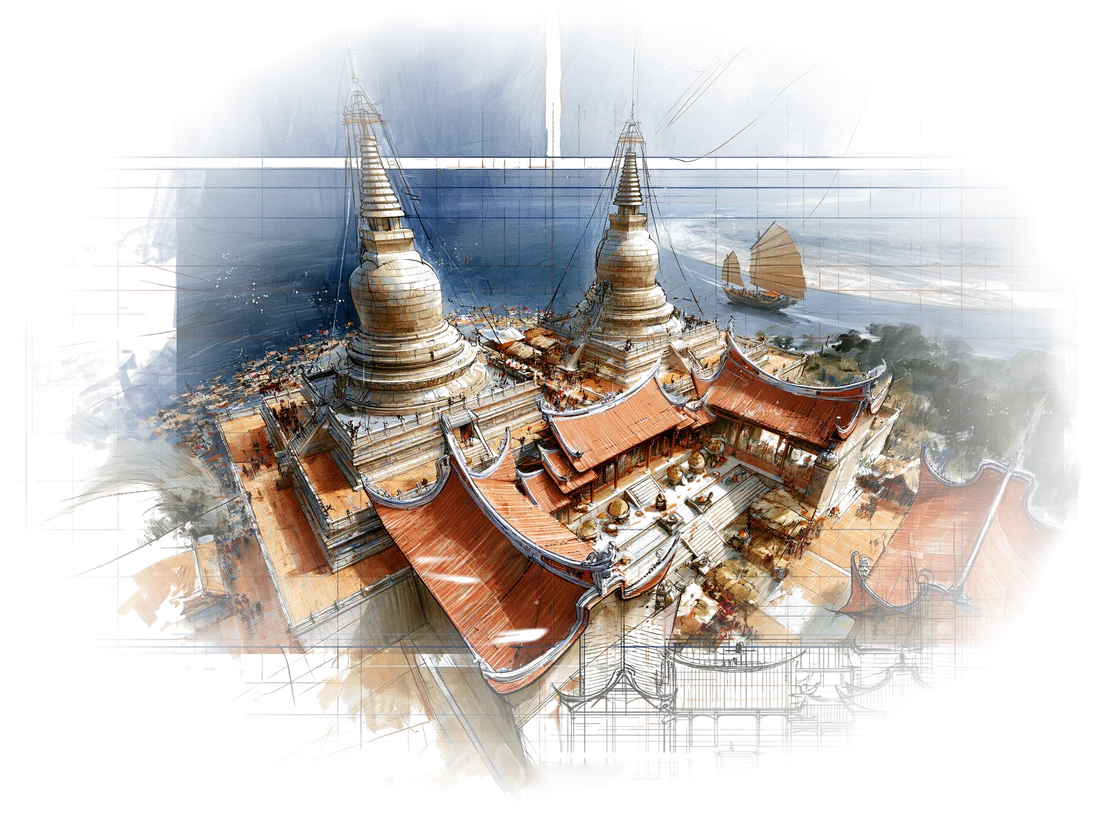
- Kaiyuan Temple (开元寺). Fujian's largest Buddhist temple, founded in the 680s and given its current name in 738. Its landmark is a pair of granite pagodas, the east Zhenguo Pagoda (镇国塔), about 48 meters tall, and the west Renshou Pagoda (仁寿塔), about 44 meters. Both began as wooden towers and were rebuilt in stone in the 13th century. They have stood through typhoons and earthquakes ever since, and their carved reliefs are worth a close look.
- West Street (西街). The lane running east from Kaiyuan Temple, said to be the oldest street in the city, now lined with snack shops, tea houses, and rooftop cafés with a view of the pagodas.
- Zhongshan Road (中山路). The old north-south spine, about 2.5 km long, lined with qilou arcade buildings from the 1920s. Many were built by returning emigrants from Southeast Asia, which is why Malay-style "five-foot ways" mix with red brick and carved window grilles. It is one of the most complete arcade streets in China.
- The Confucius temple (泉州府文庙). Founded in the Tang and moved to this site in the late 10th century, it was both the city's shrine to Confucius and its highest school. The Dacheng Hall has a sweeping double-eaved hip roof, the highest grade of roof in traditional Chinese architecture.
- Qingjing Mosque (清净寺). A short walk away on Tumen Street, one of the oldest mosques in China, founded in 1009 or 1010 and known in its Arabic inscription as the Mosque of the Companions. It was renovated in 1310 with funds from a merchant from Shiraz. The tall stone gateway, unlike anything else in mainland China, survives. The Confucius temple, the mosque, and the Guanyue Temple stand within a few hundred meters of one another.
- Tianhou Temple (天后宫). Near the old south gate, founded in 1196 and dedicated to Mazu, the sea goddess sailors prayed to before a voyage.
Two more heritage sites need a short taxi ride. Laojun Rock (老君岩), on Qingyuan Mountain north of the city, is a seated Laozi carved from a single granite boulder in the Song dynasty, about 5 meters high and 7 meters wide, the largest Song-era Taoist stone statue in China. Luoyang Bridge (洛阳桥), northeast of town, was built between 1053 and 1059 under the prefect Cai Xiang across a tidal estuary. Its builders grew oysters on the stone foundations to bind them together.
Minnan culture
Quanzhou is a heartland of Minnan (southern Fujian) culture.
- Language. Locals speak Hokkien (Minnan), which is not mutually intelligible with Mandarin or Cantonese. The Hokkien of Taiwan, Singapore, Penang, and Manila grew from the speech of Quanzhou and its neighbor Zhangzhou.
- Red brick and swallowtails. Traditional houses, called 红砖厝, are built of orange-red brick and granite, and the grander ones have swallowtail ridges (燕尾脊), roof ends that curve up and split like a swallow's tail. Temple roofs are often encrusted with figures made of cut porcelain shards.
- Nanyin (南音). A slow, elegant ensemble music sung in the Quanzhou dialect and accompanied by a vertical bamboo flute and a pipa held sideways. It is often called a "living fossil" of ancient Chinese music, and UNESCO added it to its intangible heritage list in 2009.
- Marionettes (提线木偶). Quanzhou's string-puppet theater controls each figure with as many as thirty to forty strings and keeps a repertoire of more than 700 traditional plays. It became a national intangible heritage item in 2006, and the city troupe now performs several times a week.
A city of emigrants
For centuries, people from Quanzhou sailed to Southeast Asia and Taiwan, and the city counts roughly six million overseas Chinese who trace their roots here, mostly in Southeast Asia. Their remittances built schools, arcades, and mansions back home. That is the same pattern as Chaozhou (see Chaozhou), and a big part of why Quanzhou feels both old and well-off. For what to eat while here, see Eating the southern coast.
Zayton was once the end of the Maritime Silk Road. Now it is a city that sends its own people outward.
Sources
- Quanzhou (Wikipedia)
- Quanzhou: Emporium of the World in Song-Yuan China (China Daily)
- Key landmarks in Quanzhou (China Daily)
- Kaiyuan Temple (Quanzhou) (Wikipedia)
- Qingjing Mosque (Wikipedia)
- Luoyang Bridge (Wikipedia)
- Nanyin (UNESCO Intangible Cultural Heritage)
- Fujian fishing village revels in crowning glory (People's Daily)
泉州是这条路线最后一站,也是最容易被低估的一站。今天的泉州是闽南一座富庶而低调的城市,在国内出名的是鞋服和茶叶,倒不太以旅游见长。可在七八百年前,它是世界上最繁忙的港口之一,阿拉伯和波斯商人叫它刺桐(Zayton):印度洋来的船在这里卸下胡椒、香料和珍珠,再装满丝绸和瓷器离开。那座中世纪城市的大部分遗存至今还在,散落在一片红砖老城里,走路就能逛完。我们在第 7 天坐火车抵达,第 8 天从泉州晋江机场飞回北京。
一座世界遗产港口
2021 年 7 月,第 44 届世界遗产大会在福州召开,**“泉州:宋元中国的世界海洋商贸中心”**列入《世界遗产名录》。这个项目有点特别:它不是单独一处古迹,而是由 22 处遗产点组成,年代从 10 世纪到 14 世纪,合起来讲的是一整套海洋贸易体系怎样运转。其中包括:
- 管理机构: 市舶司遗址,1087 年在此设立,负责管理、征税外国商船;还有南外宗正司遗址,是宋代管理南迁宗室的机构。
- 城市格局: 古城南门德济门遗址,以及把城池与江海连在一起的道路、桥梁和码头。
- 宗教: 佛教、道教、伊斯兰教、儒家,甚至摩尼教的遗存,还有供奉海神妈祖的宫庙。
- 生产与交通: 德化窑、磁灶窑这些烧制外销瓷的窑址,安溪的冶铁遗址,还有桥梁、码头和为进港船只指路的航标塔。
刺桐:马可·波罗与伊本·白图泰
阿拉伯语 Zaytun 的意思是“橄榄”,很可能是从泉州的别称刺桐城谐音而来。10 世纪时,城墙边遍植刺桐,故有此名。元代的刺桐是中国面向西方的头号大港。马可·波罗 13 世纪 90 年代初从这里启航,说它是世界上两个最大的商港之一。半个世纪后,14 世纪 40 年代,摩洛哥旅行家伊本·白图泰在刺桐登岸,干脆称它为世界第一大港。两人看到的都是一座多元的城市,穆斯林、基督徒、印度教徒和佛教徒比邻而居。这些痕迹至今还刻在城中博物馆收藏的墓碑和寺庙构件上。
老城
我们住在府文庙旁边,正是古城的中心,主要景点大都走得到。
- 开元寺。 福建规模最大的佛寺,始建于 7 世纪 80 年代,738 年改称今名。标志是一对花岗岩石塔:东塔镇国塔高约 48 米,西塔仁寿塔高约 44 米。两塔最初都是木塔,13 世纪改建为石塔,此后历经台风地震屹立至今,塔身浮雕值得凑近细看。
- 西街。 从开元寺往东延伸的老街,据说是泉州最早形成的街道,如今满是小吃店、茶馆和能看双塔的屋顶咖啡馆。
- 中山路。 古城南北向的主干道,全长约 2.5 公里,两侧是 20 世纪 20 年代建起的骑楼。不少是从南洋回乡的华侨所建,所以“五脚基”这类南洋符号和红砖、窗花并存,是国内保存最完整的连排骑楼街之一。
- 泉州府文庙。 始建于唐代,10 世纪后期迁到现址,既是祭孔之所,也是当时泉州的最高学府。大成殿是重檐庑殿顶,在传统建筑里属最高等级的屋顶形制。
- 清净寺。 就在涂门街上,几步路,是中国现存最古老的清真寺之一,始建于 1009 或 1010 年,阿拉伯文碑刻称之为“圣友寺”。1310 年由一位来自设拉子的商人出资重修。高大的石砌门楼在中国大陆独此一处,留存至今。府文庙、清净寺和关岳庙相距不过几百米。
- 天后宫。 靠近古城南门,始建于 1196 年,供奉海神妈祖,过去船员出海前都要来这里祈求平安。
另有两处遗产点需要打车。老君岩在城北清源山,是宋代在一整块天然花岗岩上雕出的老子坐像,高约 5 米,宽约 7 米,是中国现存最大的宋代道教石像。洛阳桥在城东北,1053 年至 1059 年间建成,时任泉州知州蔡襄主持完工,横跨潮汐江口,工匠在桥基上养殖牡蛎,把石块胶结成一体。
闽南文化
泉州是闽南文化的核心地带。
- 语言。 本地人说闽南话,和普通话、粤语都没法互通。台湾、新加坡、槟城和马尼拉的闽南话,都是从泉州和邻近漳州的口音发展出去的。
- 红砖与燕尾。 传统民居叫红砖厝,用橙红色砖和花岗岩砌成,讲究的人家屋顶是燕尾脊,屋脊两端高高翘起、分叉,像燕子的尾巴。庙宇屋顶上还常常堆满用碎瓷片拼贴出来的人物花鸟,也就是剪瓷雕。
- 南音。 一种舒缓雅致的合奏音乐,用泉州方言演唱,伴奏有洞箫和横抱的琵琶,常被称为中国古代音乐的“活化石”,2009 年列入联合国教科文组织人类非物质文化遗产代表作名录。
- 提线木偶。 泉州提线木偶一个偶人要用多达三四十根丝线操控,保存着 700 多出传统剧目,2006 年列入国家级非物质文化遗产,如今市木偶剧团每周都有好几场演出。
一座侨乡
几百年来,泉州人一批批下南洋、渡台湾,如今祖籍泉州的海外华侨华人约有六百万,大多在东南亚。他们寄回家的侨汇盖起了学校、骑楼和大厝。这和潮州是一个路数(见潮州),也是泉州既古老又殷实的一大原因。在这里吃什么,见沿着海岸吃一路。
刺桐曾是海上丝绸之路的终点。如今,它是把自己的子弟送向四海的起点。
参考资料
Where this shows up on the trip行程里对应的日子