Guangdong · 5 min read广东 · 约 5 分钟
Shunde: a city of gastronomy顺德:世界美食之都
UNESCO's City of Gastronomy: double-skin milk, fish sashimi, Qinghui Garden, and Foshan next door.联合国教科文组织认定的“世界美食之都”:双皮奶、鱼生、清晖园,隔壁就是佛山。
Ask anyone in Guangdong where to eat and sooner or later they'll say Shunde (顺德). It's a district of Foshan, just southwest of Guangzhou, flat and laced with rivers and fish ponds, and it has a reputation as the cradle of Cantonese cooking and the home of the province's best chefs. In December 2014 UNESCO made it official, naming Shunde a City of Gastronomy in its Creative Cities Network, the second Chinese city to get the title.
A water town that learned to cook
Shunde sits in the low, wet heart of the Pearl River Delta. For centuries the land was worked as mulberry dikes and fish ponds: silkworms ate the mulberry leaves, silkworm pupae fed the fish, and the pond mud fertilized the dikes. That system gave Shunde two things in abundance, freshwater fish and money from silk, and its cooks built a cuisine around them that prizes freshness, delicate knife work, and the natural taste of the ingredient. Shunde chefs are famous across the Cantonese world, and in 2004 the China Cuisine Association named the district a "hometown of Chinese chefs" (中国厨师之乡).
Today about 3.2 million people live in its 806 square kilometers, and the place is as much factory town as farm town (more on that below).
What to eat
- Double-skin milk (双皮奶). Shunde's signature dessert, from Daliang (大良), the district's old center. Whole milk, traditionally rich water buffalo milk, is heated and cooled until a skin forms; the milk underneath is poured off, mixed with egg white and sugar, poured back under the first skin, and steamed until it sets and grows a second one. Local legend credits a Daliang woman in the late Qing. In Daliang it is still served by the bowl at long-established dessert shops. The technique was listed as Guangdong provincial intangible cultural heritage in 2018.
- Fish sashimi (顺德鱼生). Paper-thin slices of raw freshwater fish, classically grass carp kept hungry in clean water for a few days beforehand to firm the flesh and lose any muddy taste. It's eaten with a spread of condiments such as shredded ginger, garlic, onion, chili, fried peanuts, and a drizzle of peanut oil. Be aware that raw freshwater fish carries a real risk of the Chinese liver fluke, a parasite common in carp. Health authorities say the only reliable protection is proper cooking or freezing.
- Daliang fried milk (大良炒牛奶). Buffalo milk and egg white, softly stir-fried into white, custardy curds, often studded with shrimp, diced char siu, or olive nuts. It dates to the early Republican era, and a deep-fried version (炸牛奶) is a common snack.
- Lunjiao cake (伦教糕). A translucent, springy white cake made from fermented rice batter and white sugar, named after Lunjiao (伦教) in Shunde. It's lightly sweet with a faint tang from the fermentation.
- Jun'an steamed pig (均安蒸猪). A whole pig, marinated and laid flat in a wooden box, then steamed over high heat, from Jun'an (均安) in the south of the district. The technique dates from the Tongzhi reign (1862 to 1874) and grew out of the region's ancestral-hall culture.
Shunde food is also about the everyday: congee hotpot, roast goose over thick lai fun rice noodles, and the street snacks of Daliang's old lanes. More in Eating the southern coast.
Qinghui Garden
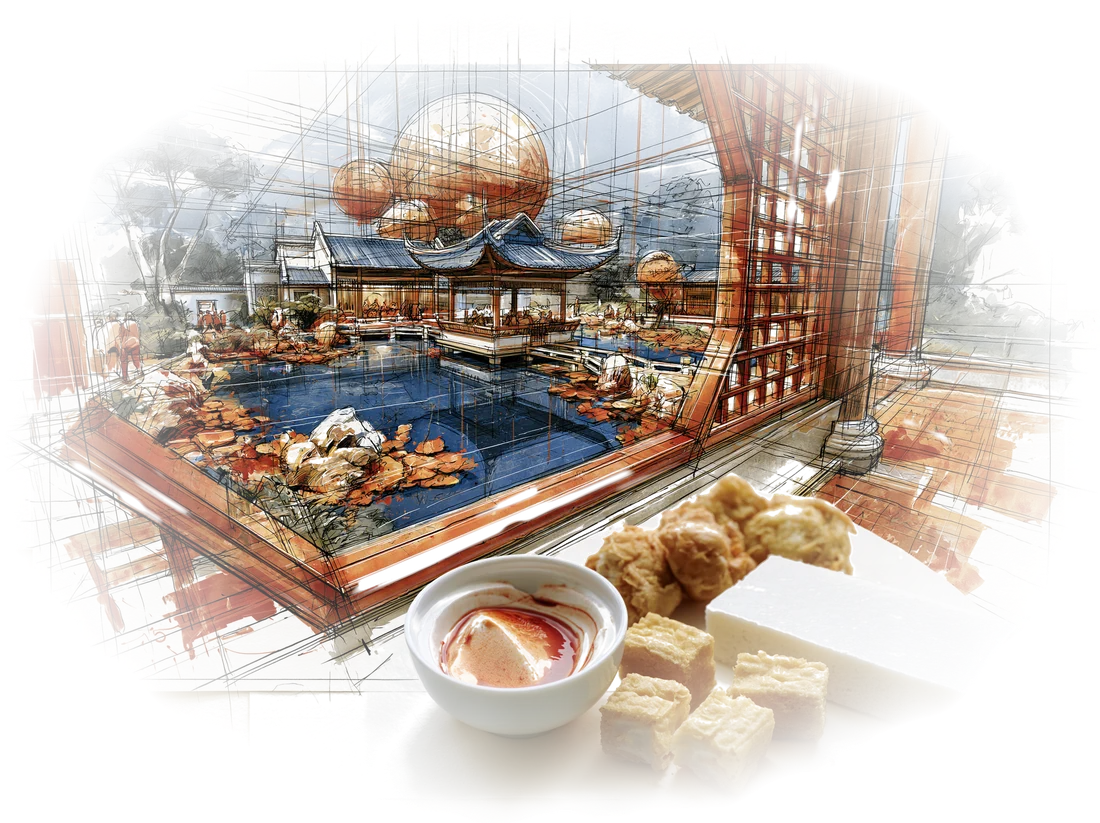
Qinghui Garden (清晖园), in central Daliang, is one of the four great gardens of Lingnan (岭南四大名园), together with Yuyin Shanfang in Panyu, Keyuan in Dongguan, and Liangyuan in Foshan. It began as the family garden of Huang Shijun, a Shunde man who placed first in the palace examination in 1607. When the Huang family declined in the Qing, the Long family bought it and built it out. The name, "Garden of Pure Splendor," was hung over the gate in 1806, and compares a parent's kindness to warm sunlight. Unlike the gray-and-white gardens of Suzhou, Lingnan gardens are compact and built for heat: shaded courtyards, open pavilions, ponds, colored glass windows, and lush tropical planting. It's now a national key cultural relic.
Foshan next door
Foshan proper, a short ride north, is worth knowing about. Its centerpiece is the Foshan Ancestral Temple (祖庙), a Daoist temple to Beidi, the god of the north and of water, first built in the Northern Song (1078 to 1085) and rebuilt in 1372. The complex now includes memorial halls to Wong Fei-hung and Ip Man, and hosts martial arts shows, Cantonese opera, and lion dancing. The southern lion dance, with its big-eyed, blinking lion heads, is closely tied to Foshan.
Shunde the factory town
The fish ponds are only half the story. Shunde is also one of China's richest manufacturing districts. The appliance giant Midea (美的) and the property developer Country Garden (碧桂园) are both headquartered here, and both have been Fortune Global 500 companies. That mix of wealth and old water-town habits is part of why Shunde eats so well.
Shunde fills Day 3, Day 4, and the morning of Day 5, before the train to Chaozhou.
In Shunde the highest praise for a dish is that it tastes of itself.
Sources
- UNESCO: Shunde City of Gastronomy membership monitoring report (2018)
- Wikipedia (Chinese): 顺德区
- Wikipedia (Chinese): 双皮奶
- Wikipedia (Chinese): 清晖园
- Hong Kong Centre for Food Safety: Food safety of freshwater fish sashimi
- Southcn: 牛奶的二次新生 (Shunde buffalo-milk dishes)
- Wikipedia: Foshan Ancestral Temple
- Shunde Library: 均安蒸猪制作技艺 (Jun'an steamed pig)
在广东问人去哪儿吃,问来问去,迟早会有人说:顺德。顺德是佛山的一个区,就在广州西南边,地势平坦,河涌和鱼塘交织,向来被看作粤菜的发源地之一、好厨师的老家。2014 年 12 月,联合国教科文组织正式授予顺德“美食之都”称号,纳入创意城市网络,顺德是中国第二个拿到这块牌子的城市。
一个学会了做菜的水乡
顺德地处珠三角低洼多水的腹地。几百年来,这里的土地以桑基鱼塘的方式耕作:桑叶喂蚕,蚕蛹喂鱼,塘泥又回到基上肥桑。这套系统给顺德带来了两样东西,一是吃不完的河鲜,二是蚕丝换来的钱。顺德厨师围绕它们发展出一套讲究鲜、讲究刀工、讲究吃原味的菜。顺德大厨在整个粤菜圈都有名,2004 年中国烹饪协会授予顺德“中国厨师之乡”称号。
如今顺德 806 平方公里的土地上住着约 320 万人,它既是鱼米之乡,也是工厂之乡(后面细说)。
吃什么
- 双皮奶。 顺德的招牌甜品,出自老城区大良。传统用浓稠的水牛奶,加热后放凉,表面结出一层奶皮;把下面的奶倒出来,拌入蛋清和糖,再沿碗边倒回第一层奶皮底下,隔水蒸到凝固,又结出第二层皮。民间传说是清末大良一位妇人琢磨出来的。如今在大良,还能在几十年的老甜品铺里按碗吃到。双皮奶制作技艺 2018 年列入广东省非物质文化遗产。
- 顺德鱼生。 鲜活淡水鱼切成薄如蝉翼的片生吃,传统上用鲩鱼(草鱼),宰杀前先放在清水里饿养几天,让肉质紧实、去掉泥腥味。吃的时候配一大桌佐料,姜丝、蒜片、洋葱丝、辣椒、炸花生,再淋一点花生油。要提醒一句:生吃淡水鱼有感染华支睾吸虫(肝吸虫)的实际风险,这种寄生虫在鲤科鱼里很常见。卫生部门的说法是,真正可靠的办法只有彻底煮熟或冷冻处理。
- 大良炒牛奶。 水牛奶加蛋清,用软炒法炒成雪白嫩滑的奶块,常配虾仁、叉烧粒或榄仁。这道菜诞生于民国初年,还有一个油炸的版本叫炸牛奶,是常见的小吃。
- 伦教糕。 用发酵的米浆和白糖蒸成的白糖糕,晶莹、有弹性,得名于顺德伦教。甜得很淡,带一丝发酵的微酸。
- 均安蒸猪。 出自顺德南部的均安:整头猪腌好后摊平在特制的杉木盒里,旺火隔水蒸熟。这门手艺始于清同治年间(1862 至 1874 年),和当地的祠堂文化分不开。
顺德的好吃也在家常里:粥底火锅、烧鹅濑粉,还有大良老街巷里的各种小吃。更多见沿着海岸吃一路。
清晖园
大良城中的清晖园是岭南四大名园之一,另外三座是番禺的余荫山房、东莞的可园和佛山的梁园。它的前身是顺德人黄士俊的家园,黄士俊在 1607 年高中状元。清代黄家衰落,园子被龙氏家族买下并不断扩建。“清晖园”三个字 1806 年题上园门,寓意父母之恩如和煦的阳光。和苏州园林的粉墙黛瓦不同,岭南园林小巧紧凑,处处为暑热着想:遮阴的庭院、通透的亭榭、水池、彩色玻璃窗,还有繁茂的热带植物。现在是全国重点文物保护单位。
隔壁的佛山
往北不远就是佛山城区,值得了解一下。核心是佛山祖庙,供奉北帝(真武大帝,掌管水的北方之神),始建于北宋元丰年间(1078 至 1085 年),明代 1372 年重建。如今祖庙里还有黄飞鸿纪念馆和叶问堂,常年有武术表演、粤剧和舞狮。大眼睛、会眨眼的南狮,和佛山渊源极深。
工厂之乡顺德
鱼塘只是故事的一半。顺德也是全国最富的制造业强区之一。家电巨头美的和地产商碧桂园的总部都在这里,两家都进过世界 500 强。富起来的钱,加上老水乡的饮食习惯,正是顺德这么能吃的原因之一。
在顺德的日子是第 3 天、第 4 天和第 5 天上午,然后坐火车去潮州。
在顺德,夸一道菜最高的说法是:吃得出它本来的味道。
参考资料
Where this shows up on the trip行程里对应的日子