The capital · 4 min read首都 · 约 4 分钟
Astana: the steppe capital阿斯塔纳:草原上的首都
A capital built from scratch after 1997: Kurokawa's master plan, Bayterek, Khan Shatyr, Hazret Sultan and the Expo sphere.1997 年后平地而起的首都:黑川纪章的总体规划、巴伊杰列克观景塔、可汗之帐、哈兹拉特苏丹清真寺和世博球馆。
Astana is a capital that was, in large part, decided into existence. In 1997 Kazakhstan's first president, Nursultan Nazarbayev, moved the seat of government from Almaty, a lovely, established city in the far southeast, to a modest provincial town on the Ishim (Esil) River in the middle of the northern steppe. Then the country spent a quarter-century of oil revenue building a skyline to match.
Why move the capital?
The official reasons were practical. Almaty sits in an earthquake zone, it is hemmed in by mountains with no room to grow, and it lies close to the Chinese and Kyrgyz borders. A central location was better for a country this big. The unofficial reasons are often read as political: a northern capital anchored the heavily Russian-populated north to the new Kazakh state, and a fresh city gave the new country a fresh symbol.
The government formally relocated on December 10, 1997.
Five names in a century
The city has changed its name more than almost any capital on Earth:
- Akmolinsk, a Russian fort-town founded in the 1830s.
- Tselinograd (1961), "Virgin Lands City," the hub of Khrushchev's campaign to plow the northern steppe.
- Akmola (1991), usually glossed as "white grave" or "white shrine."
- Astana (1998), which simply means "capital" in Kazakh.
- Nur-Sultan (2019–2022), renamed for Nazarbayev when he stepped down as president.
- Astana again (2022), after his successor, Kassym-Jomart Tokayev, reversed the change.
The master plan
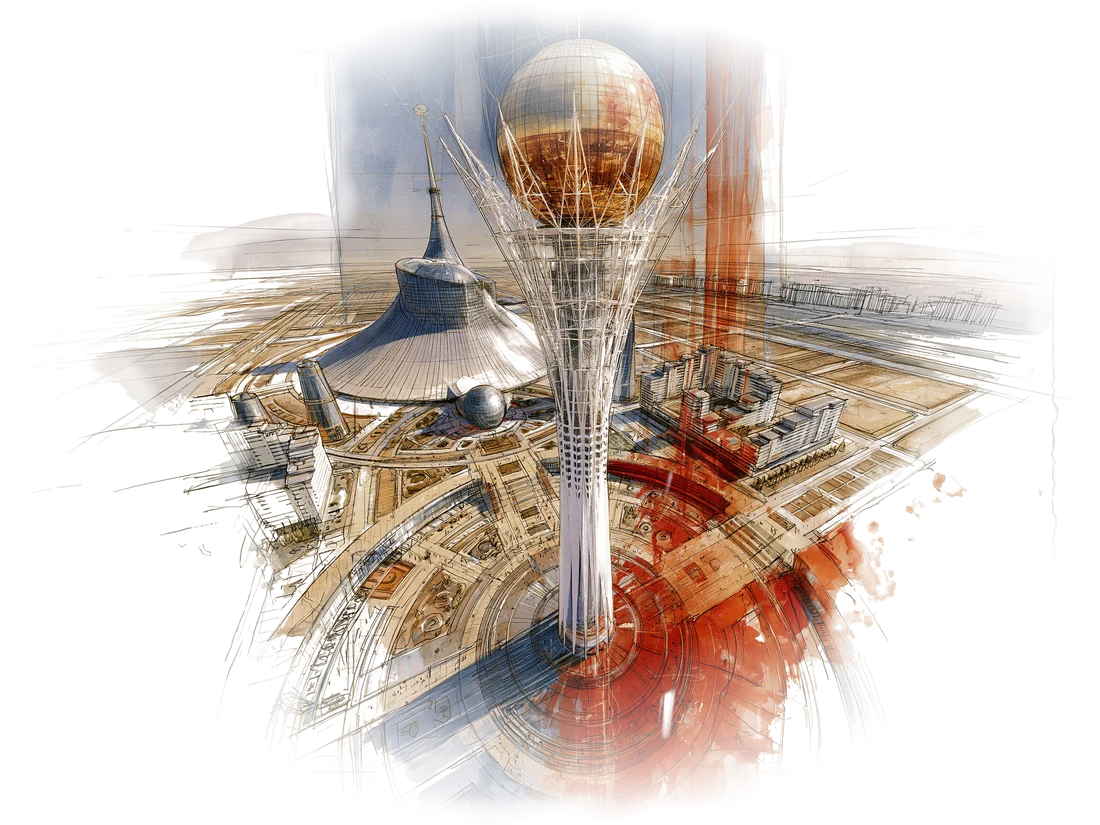
In 1998 the Japanese architect Kisho Kurokawa, a founder of the Metabolist movement, won the competition to plan the new capital. His idea was "symbiosis": keep and renew the old town on the right bank of the river, and grow a new administrative city on the left bank, laid out along a long ceremonial axis. Kurokawa's plan has been revised many times since, but the axis is the spine of the Left Bank today, running from the presidential palace past the Bayterek tower to the Khan Shatyr tent.
The big pieces
- Bayterek. The city's emblem: a white lattice "tree" 105 meters tall, holding a golden glass sphere. It illustrates a Kazakh legend in which the mythical bird Samruk lays a golden egg in the branches of the tree of life. The observation deck sits at 97 meters, a nod to 1997. At the top you can press your palm into a gilded cast of Nazarbayev's handprint and make a wish. Built 1996–2002.
- Khan Shatyr. A giant translucent tent by Foster + Partners, about 150 meters high, opened in 2010. Inside is a shopping and entertainment center with an indoor beach, heated to summer temperatures in a city where winters reach −40°C.
- Hazret Sultan Mosque. A white, classical-style mosque with four 77-meter minarets and a 51-meter dome, opened in 2012. For a decade it was the largest mosque in Central Asia, until the even bigger Astana Grand Mosque opened in 2022. "Hazret Sultan" (Holy Sultan) is an epithet of the Sufi master Khoja Ahmed Yasawi. Visitors are welcome outside prayer times; dress modestly, and women should bring a scarf.
- Palace of Peace and Reconciliation. Foster's glass pyramid (2006), built to host a congress of world religions. It sits across the river from the mosque.
- Nur Alem. The 80-meter glass sphere that served as Kazakhstan's pavilion at Expo 2017, whose theme was "Future Energy." Billed as the world's largest spherical building, it's now a museum of future energy, with a floor for each energy source. The old Expo grounds around it have become a business and tech district, which is where Day 2's AI Month program takes place.
How to read it
Astana can feel like a scale model enlarged to full size: huge boulevards, monumental buildings, not many people walking between them. It's easy to be cynical about it, and plenty of Kazakhs are. But it is also a genuinely interesting experiment in what a young country thinks it should look like, built fast and without much restraint. The best way in is on foot along the central axis at dusk, when the buildings light up in turn, and then across the river into the older, lower, more ordinary city where people actually live.
Astana is a new country's self-portrait, drawn in glass and steel on a blank sheet of steppe.
阿斯塔纳这座首都,很大程度上是被一纸决定“变”出来的。1997 年,哈萨克斯坦首任总统努尔苏丹·纳扎尔巴耶夫把政府驻地从阿拉木图(东南角一座宜人又成熟的城市)迁到北方草原腹地、伊希姆河(叶西尔河)畔一座不起眼的外省小城。随后,国家花了四分之一个世纪的石油收入,给它配上了一条相称的天际线。
为什么要迁都?
官方理由很务实。阿拉木图地处地震带,被群山围住没有扩展余地,又离中国和吉尔吉斯斯坦边境太近。对这么大的国家来说,居中的位置更合适。非官方的解读则多半偏政治:首都北迁,能把俄罗斯族聚居的北方牢牢拴在新生的哈萨克国家上;一座全新的城市,也给这个全新的国家一个全新的象征。
政府于 1997 年 12 月 10 日正式迁入。
一个世纪,五个名字
这座城改名的次数,在全世界的首都里恐怕数一数二:
- 阿克莫林斯克,1830 年代俄国人建的要塞小城。
- 采利诺格勒(1961),意即“垦荒城”,是赫鲁晓夫开垦北方草原运动的中心。
- 阿克莫拉(1991),一般译作“白色坟墓”或“白色圣所”。
- 阿斯塔纳(1998),哈萨克语里就是“首都”的意思。
- 努尔苏丹(2019–2022),纳扎尔巴耶夫卸任总统时以他的名字命名。
- 再度改回阿斯塔纳(2022),继任者卡西姆若马尔特·托卡耶夫撤销了那次改名。
总体规划
1998 年,日本建筑师黑川纪章(新陈代谢派的创始人之一)赢得了新首都的规划竞赛。他的理念是“共生”:保留并更新河右岸的老城,在左岸另起一座行政新城,沿一条长长的礼仪轴线展开。此后规划改过很多次,但这条轴线至今仍是左岸的脊梁,从总统府出发,经过巴伊杰列克观景塔,一直延伸到可汗之帐。
几座大件
- 巴伊杰列克观景塔。 城市的标志:一棵 105 米高的白色网格“树”,托着一颗金色玻璃球。它演绎的是一则哈萨克传说:神鸟萨姆鲁克在生命之树的枝头产下一枚金蛋。观景台设在 97 米高处,暗合 1997 年。顶层有一只纳扎尔巴耶夫的镀金手印,你可以把手掌按进去许个愿。1996–2002 年建成。
- 可汗之帐。 福斯特建筑事务所设计的巨型半透明帐篷,高约 150 米,2010 年开业。里面是购物娱乐中心,还有一片室内沙滩,常年保持夏天的温度,而这座城的冬天能冷到零下 40°C。
- 哈兹拉特苏丹清真寺。 一座古典风格的白色清真寺,四座宣礼塔各高 77 米,穹顶高 51 米,2012 年落成。此后十年它一直是中亚最大的清真寺,直到 2022 年更大的阿斯塔纳大清真寺启用。“哈兹拉特苏丹”(神圣的苏丹)是苏菲大师霍贾·艾哈迈德·亚萨维的尊称。非礼拜时间欢迎参观;着装要保守,女士请带一条头巾。
- 和平与和解宫。 福斯特设计的玻璃金字塔(2006),为举办世界宗教大会而建,与清真寺隔河相望。
- 努尔·阿莱姆球馆。 一颗直径 80 米的玻璃球,是2017 年世博会的哈萨克斯坦国家馆,那届世博会的主题是“未来能源”。号称世界最大的球形建筑,如今是一座未来能源博物馆,每层讲一种能源。周边的世博园区已改造成商务和科技区,第二天“AI 月”的活动就在这里。
怎么看这座城
阿斯塔纳有时像一个被放大到一比一的沙盘:大道极宽,建筑极宏伟,楼与楼之间却没什么行人。对它冷嘲热讽很容易,不少哈萨克人自己也这么做。但它同时也是一场真正有意思的实验:一个年轻的国家觉得自己应该长什么样,于是造得飞快,也毫不收敛。最好的打开方式,是黄昏时沿中轴线步行,看两旁的建筑一栋栋亮起灯来,然后过河,走进那片更老、更矮、更寻常、人们真正在其中生活的城区。
阿斯塔纳是一个新国家的自画像,用玻璃和钢,画在一张空白的草原上。
Where this shows up on the trip行程里对应的日子