Before you go · 4 min read出发之前 · 约 4 分钟
Kazakhstan in five minutes五分钟读懂哈萨克斯坦
The ninth-largest country on Earth: steppe, two rival cities, one time zone, two languages and a Soviet past.世界第九大国:草原、两座较劲的城市、一个时区、两种语言,还有一段苏联往事。
Kazakhstan is the kind of country that's easier to feel than to picture. It is the ninth-largest country in the world and the largest landlocked one, about 2.7 million square kilometers, roughly the size of Western Europe. Yet only about 20.5 million people live in it, fewer than in greater Beijing.
Mostly steppe
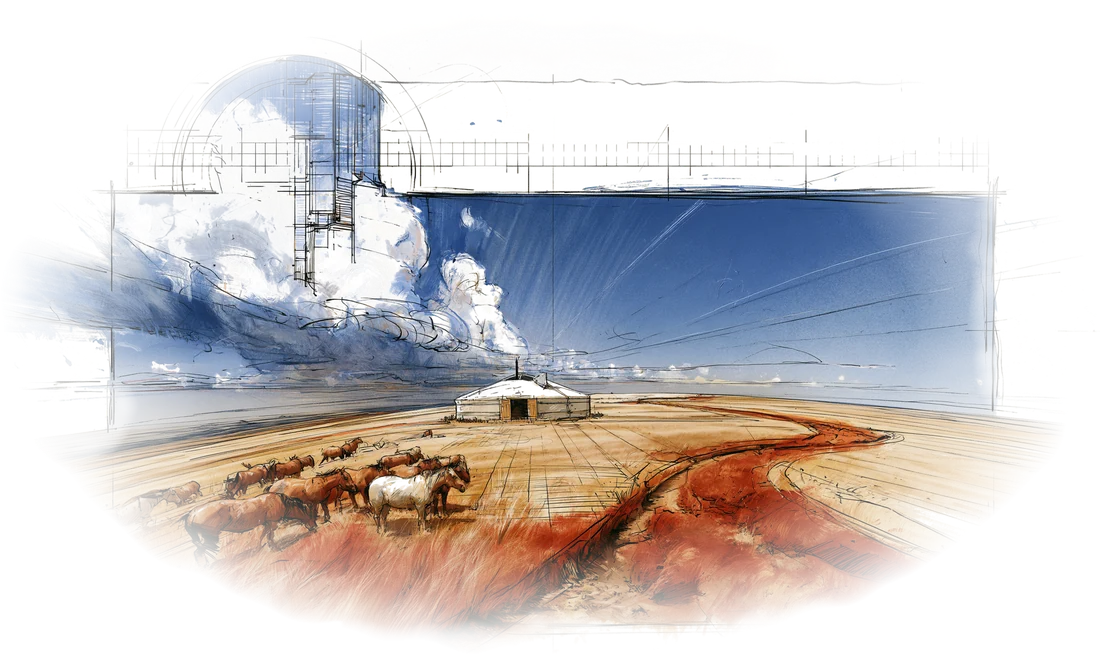
Most of that space is steppe: grassland that shades into semi-desert toward the south and west. For roughly three thousand years this was horse country, the heart of the nomadic world. Kazakh identity still leans on it. The yurt (kiiz uy) on the national emblem, the dombra (a two-stringed lute), horse racing and eagle hunting are all echoes of a life spent moving herds between summer and winter pastures.
The edges are where the drama is. To the southeast, the Tian Shan rises to glaciers and 5,000-meter-plus peaks above Almaty. To the west, the land drops toward the Caspian Sea, part of which sits below sea level. This trip samples both ends and the middle.
Two cities, one argument
Almaty in the far south is the old capital: the biggest city (over 2 million), the business and cultural center, leafy and relaxed. Astana in the north is the new capital, chosen in 1997 and built up with oil money into a skyline of statement architecture. Almaty people tend to find Astana cold and a little artificial. Astana people point out that it gets things done. You'll see both and can pick a side.
One clock
Since March 1, 2024, the whole country runs on a single time zone, UTC+5. Before that, most of the east (including Astana and Almaty) was on UTC+6. The change was made to put the country on one working day. So Kazakhstan is three hours behind Beijing, and there's no clock change between Astana, Aktau and Almaty.
Languages
Kazakh, a Turkic language related to Uzbek, Kyrgyz and Turkish, is the state language. Russian is also official and remains the everyday lingua franca in the cities, especially Almaty. Signs are often in both, sometimes in English. Kazakh is slowly moving from Cyrillic to a Latin alphabet, so you may see the same word spelled several ways (Qazaqstan, Kazakhstan; Shymbulak, Chimbulak).
A few words go a long way:
- Salem (сәлем) means hi. Salemetsiz be is the polite hello.
- Rakhmet (рахмет) means thank you. People are visibly pleased when a foreigner uses it.
- Sau bolyңyz means goodbye (polite).
- Iya / zhok means yes / no.
- In Russian: spasibo (thanks), skol'ko? (how much?).
Religion, lightly worn
About 70% of Kazakhs are Muslim (Sunni, of the Hanafi school), and there are large Orthodox Christian communities, mostly among ethnic Russians. But the state is firmly secular, and religion here tends to be woven into custom rather than worn on the sleeve. Alcohol is sold everywhere, headscarves are a minority choice in the cities, and a pilgrimage to a Sufi saint's cave in the desert can sit comfortably next to a bottle of cognac at dinner. Nomadic traditions blended Islam with older steppe beliefs, and you'll see that mix at shrines in Mangystau, with cloth ribbons tied to trees and offerings at graves.
The Soviet layer
Kazakhstan was part of the Russian Empire and then the USSR until it declared independence on December 16, 1991, the last Soviet republic to do so. The twentieth century was brutal here. Forced collectivization in the early 1930s triggered a famine that killed well over a million Kazakhs. The steppe became a destination for deportees and labor camps, the site of the Soviet nuclear testing ground at Semipalatinsk, and home to the Baikonur space launch site. Khrushchev's Virgin Lands campaign plowed up the northern steppe (Astana was renamed Tselinograd, "Virgin Lands City," in its honor).
You'll feel the legacy in small things: the Russian that everyone speaks, the Soviet apartment blocks and mosaics, the Ladas, the vodka toasts. It sits alongside a newer, deliberate Kazakh nation-building project that's visible in every monument you'll pass.
A country the size of Western Europe with the population of a single megacity: space is the first thing Kazakhstan gives you.
哈萨克斯坦这个国家,与其说能想象出来,不如说要身临其境才体会得到。它是世界第九大国,也是最大的内陆国,面积约 270 万平方公里,差不多有整个西欧那么大。可全国只住着约 2050 万人,比大北京地区的人口还少。
大半是草原
这片土地大部分是草原:往南、往西逐渐过渡成半荒漠。大约三千年来,这里一直是马背上的天地,是游牧世界的腹地。哈萨克人的身份认同至今仍扎根于此。国徽上的毡房(kiiz uy)、冬不拉(一种两弦琵琶)、赛马和猎鹰,都是那段逐水草而居、在夏牧场和冬牧场之间转场的生活留下的回声。
真正壮观的是边缘地带。东南方向,天山在阿拉木图背后拔地而起,冰川覆顶,山峰高过 5000 米。西边,地势一路向里海低下去,有一部分甚至低于海平面。这趟旅行两头和中间都会走到。
两座城,一场争论
南端的阿拉木图是老首都:全国最大的城市(人口超过 200 万),商业和文化中心,绿树成荫,节奏松弛。北方的阿斯塔纳是新首都,1997 年选定,靠石油收入堆出了一条满是标志性建筑的天际线。阿拉木图人往往嫌阿斯塔纳冷冰冰、有点假;阿斯塔纳人则会提醒你,这座城办事效率高。两边你都会去,站哪一队自己定。
一个时区
自 2024 年 3 月 1 日起,全国统一使用一个时区,UTC+5。此前东部大部分地区(包括阿斯塔纳和阿拉木图)用的是 UTC+6。改时区是为了让全国在同一个工作日节奏里运转。所以哈萨克斯坦比北京晚三小时,阿斯塔纳、阿克套、阿拉木图之间也不用倒表。
语言
哈萨克语是国语,属突厥语族,与乌兹别克语、吉尔吉斯语、土耳其语是亲戚。俄语同为官方语言,在城市里仍是日常通用语,阿拉木图尤其如此。路牌多为双语,有时还配英文。哈萨克语正在慢慢从西里尔字母改用拉丁字母,所以同一个词你可能会看到好几种拼法(Qazaqstan 和 Kazakhstan;Shymbulak 和 Chimbulak)。
会几个词,很管用:
- Salem(сәлем)是“嗨”。Salemetsiz be 是客气些的“您好”。
- Rakhmet(рахмет)是“谢谢”。外国人说这个词,对方会明显高兴。
- Sau bolyңyz 是“再见”(敬语)。
- Iya / zhok 是“是 / 不是”。
- 俄语的话:spasibo(谢谢),skol'ko?(多少钱?)。
宗教,淡淡的
约 70% 的哈萨克人是穆斯林(逊尼派,哈乃斐学派),另有规模不小的东正教群体,主要是俄罗斯族。但国家坚定地奉行世俗化,宗教在这里更多是融进风俗,而不是挂在脸上。酒随处都能买到,城里戴头巾的是少数;白天去荒漠里朝拜一位苏菲圣人的洞窟,晚饭桌上照样摆一瓶白兰地,两不相妨。游牧传统把伊斯兰教和更古老的草原信仰揉在了一起,在曼格斯套的圣地你会看到这种混合:树上系满布条,坟前摆着供品。
苏联那一层
哈萨克斯坦先后属于俄罗斯帝国和苏联,直到 1991 年 12 月 16 日宣布独立,是最后一个宣布独立的苏联加盟共和国。二十世纪对这里格外残酷。1930 年代初的强制集体化引发大饥荒,饿死的哈萨克人远超一百万。草原成了流放者和劳改营的去处,塞米巴拉金斯克是苏联的核试验场,拜科努尔是航天发射场。赫鲁晓夫的垦荒运动把北方草原翻了个遍(阿斯塔纳还因此改名为“采利诺格勒”,意即“垦荒城”)。
这份遗产藏在许多小地方:人人会说的俄语,苏式住宅楼和马赛克壁画,满街的拉达车,一轮接一轮的伏特加祝酒。与之并行的,是一场刻意推进的、更新的哈萨克国家建构,你路过的每一座纪念碑都看得出来。
一个西欧大小的国家,人口不过一座超大城市:哈萨克斯坦给你的第一样东西,就是空间。
Where this shows up on the trip行程里对应的日子