Before you go · 4 min read出发之前 · 约 4 分钟
New Zealand in five minutes五分钟读懂新西兰
New Zealand is a long, narrow country in the South Pacific, about 1,500 km from top to bottom and roughly 2,000 km east of Australia across the Tasman Sea. It's a bit bigger than the United Kingdom in area, with about 5.3 million people. There are far more sheep than people, though the gap has been closing for decades as farms switch to dairy cows.
Two islands on a plate boundary
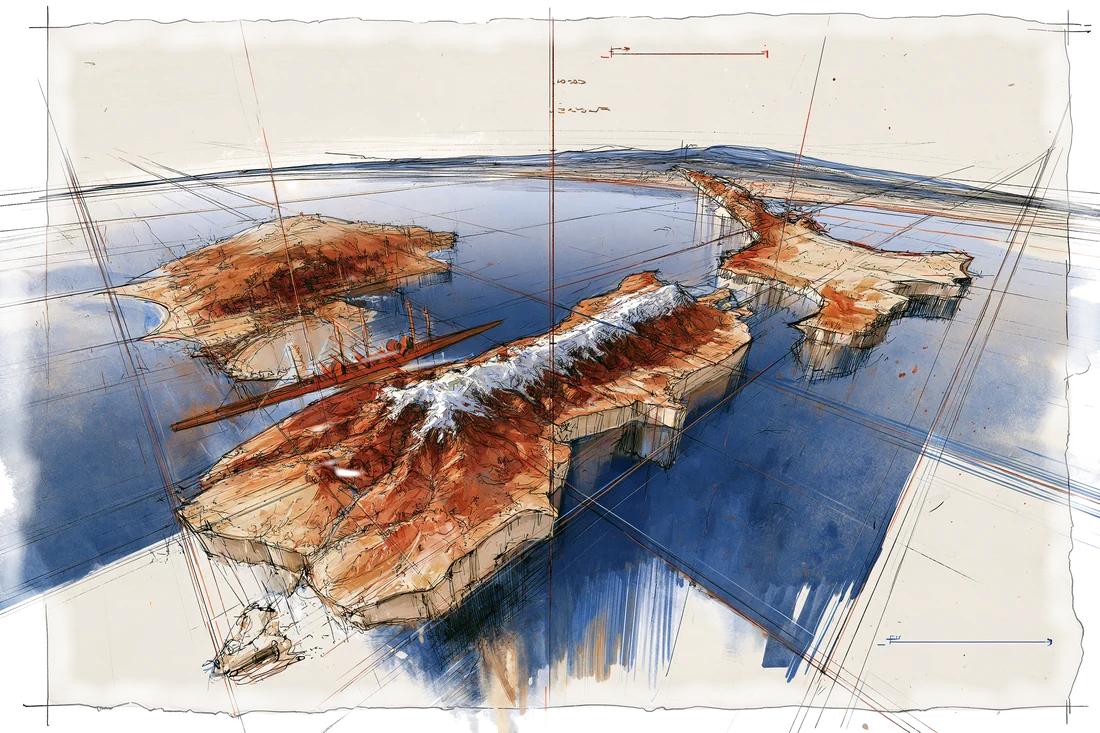
The country is mostly two big islands. The South Island is the larger and emptier one, with the Southern Alps running down its spine. The North Island is smaller but holds about three-quarters of the population, including Auckland, the biggest city, and Wellington, the capital. They are separated by Cook Strait, which we cross on the Interislander ferry.
Both islands exist because of where they sit: on the boundary between the Pacific and Australian tectonic plates. In the north, the Pacific plate dives under the Australian plate, which feeds the volcanoes of the central North Island and the geothermal steam of Rotorua and Taupō. In the south, the two plates grind sideways past each other along the Alpine Fault, pushing up the Southern Alps. That's why New Zealand gets so many earthquakes (it's nicknamed "the Shaky Isles"), and why, in three weeks, the trip moves through glaciers, fiords, volcanoes and geysers.
Aotearoa
Aotearoa is the Māori name for New Zealand, usually translated as "land of the long white cloud." It originally referred to the North Island, but today it's used for the whole country, often side by side with the English name, on passports, banknotes and government websites. "New Zealand" itself came from Dutch mapmakers after Abel Tasman's 1642 voyage, via the Dutch province of Zeeland.
Māori and Pākehā
Māori are the Indigenous people of New Zealand. Their ancestors sailed here from eastern Polynesia in voyaging canoes around 1250–1300 CE, which makes New Zealand one of the last major landmasses on Earth to be settled by people. In the 2023 census, about 18 percent of New Zealanders identified as Māori.
Pākehā is the Māori word for New Zealanders of European descent, and it's in everyday, neutral use. The country's founding document is the Treaty of Waitangi (Te Tiriti o Waitangi), signed in 1840 between the British Crown and many Māori chiefs. The English and Māori versions say different things, and the gap between them shaped much of the country's history. Since the 1970s, a formal process has been settling Māori claims against the Crown, which is why you'll see land, rivers and mountains with restored Māori names, and why some places, such as Aoraki/Mt Cook, carry two names joined by a slash.
The trip overlaps with Waitangi Day, February 6, the national day, marking the signing of the treaty. It's a public holiday, so expect some shops to close and some roads, campsites and ferries to be busy.
A few words of te reo
Te reo Māori ("the language") has been an official language since 1987, and it's woven into ordinary New Zealand English. You'll hear these constantly:
- Kia ora — hello, thanks, cheers. The all-purpose greeting.
- Kia ora koutou — hello, everyone.
- Haere mai — welcome. Nau mai, haere mai is the fuller version.
- Ka pai — good, well done.
- Whānau — family, extended family.
- Kai — food.
- Moana — sea. Maunga — mountain. Roto — lake. Wai — water.
Pronunciation is easier than it looks. Vowels are pure, as in Spanish or Italian. A macron (ā, ē, ī, ō, ū) means the vowel is held longer. Wh is usually said like a soft English f, so whānau sounds like "far-no." And "Māori" itself is closer to "MAH-aw-ree" than "MAO-ree."
Summer in January
Everything is flipped from the north: late January and early February is high summer, school holidays have just ended, and it's the busiest, sunniest part of the year. Expect daytime temperatures from the high teens to mid-20s °C in most places, warmer in the north. But the weather is famously changeable. Fiordland and the West Coast get rain year-round, and on the Tongariro Crossing or up Roy's Peak it can go from warm sun to cold wind and cloud within an hour. Bring layers and a proper rain jacket everywhere.
The sun is the real hazard. The ozone layer over this part of the world is thinner, the air is clear and unpolluted, and UV levels in summer are among the highest anywhere. You can burn in 10 to 15 minutes at midday. Sunscreen, sunglasses and a hat, every day, even when it's cool.
The clock is NZDT, UTC+13, five hours ahead of Beijing. Daylight saving runs until the first Sunday of April.
Two islands pushed up by colliding plates, settled last of all the world's great landmasses, and named twice: New Zealand and Aotearoa.
新西兰是南太平洋上一个狭长的国家,南北长约 1500 公里,隔着塔斯曼海,在澳大利亚以东约 2000 公里。国土面积比英国略大,人口约 530 万。羊比人多得多,不过几十年来牧场纷纷改养奶牛,这个差距一直在缩小。
板块边界上的两座岛
新西兰主要由两座大岛组成。南岛面积更大,也更空旷,南阿尔卑斯山像一条脊梁贯穿全岛。北岛小一些,却住着全国约四分之三的人口,最大城市奥克兰和首都惠灵顿都在北岛。两岛之间隔着库克海峡,我们会搭岛际渡轮横渡。
这两座岛之所以存在,全因为它们的位置:正好压在太平洋板块和澳大利亚板块的交界线上。在北边,太平洋板块俯冲到澳大利亚板块之下,喂养了北岛中部的火山群,也造就了罗托鲁瓦和陶波的地热蒸汽。在南边,两块板块沿着阿尔卑斯断层横向错动、互相挤压,把南阿尔卑斯山推了起来。所以新西兰地震频繁,外号“摇晃的群岛”(the Shaky Isles);也正因如此,这短短三个星期里,我们能一路看到冰川、峡湾、火山和间歇泉。
Aotearoa
Aotearoa(奥特亚罗瓦)是新西兰的毛利语名字,通常译作“长白云之乡”。它最初指的只是北岛,如今已用来称呼整个国家,在护照、钞票和政府网站上常常与英文名并列。“New Zealand”这个名字则来自荷兰制图师:1642 年阿贝尔·塔斯曼航行至此之后,人们借用了荷兰的泽兰省(Zeeland)来命名。
毛利人与 Pākehā
毛利人是新西兰的原住民。他们的祖先约在公元 1250 至 1300 年间,乘远洋独木舟从东波利尼西亚航行而来,这让新西兰成为地球上最晚有人定居的大块陆地之一。在 2023 年人口普查中,约 18% 的新西兰人认同自己是毛利族裔。
Pākehā(帕克哈)是毛利语里对欧洲裔新西兰人的称呼,日常通用,不带褒贬。新西兰的立国文件是 《怀唐伊条约》(Te Tiriti o Waitangi),1840 年由英国王室与众多毛利酋长签订。条约的英文版和毛利文版说法并不一致,两者之间的落差,在很大程度上塑造了这个国家后来的历史。自 1970 年代起,政府通过一套正式程序,陆续处理毛利人对王室的土地索赔。这就是为什么你会看到许多土地、河流和山峰恢复了毛利名字,有些地方还用斜杠并列两个名字,比如 Aoraki/Mt Cook,也就是库克山(奥拉基)。
旅程正好赶上 2 月 6 日怀唐伊日,这是纪念条约签订的国庆日,全国放假。有些商店会关门,部分道路、营地和渡轮会比平时拥挤。
几句毛利语
Te reo Māori(“那门语言”,即毛利语)自 1987 年起就是官方语言,而且早已融进新西兰人日常说的英语里。下面这些词你会反复听到:
- Kia ora:你好、谢谢、干杯,万能问候语。
- Kia ora koutou:大家好。
- Haere mai:欢迎。更完整的说法是 Nau mai, haere mai。
- Ka pai:好、干得漂亮。
- Whānau:家人,也指大家族。
- Kai:食物。
- Moana 是海,Maunga 是山,Roto 是湖,Wai 是水。
发音比看上去容易。元音都是纯元音,跟西班牙语、意大利语差不多。字母上的长音符号(ā、ē、ī、ō、ū)表示这个元音要拖长。Wh 通常读得像轻轻的 f,所以 whānau 听起来像“发—闹”。“Māori”本身的读音也更接近“马—奥—里”,而不是英语里常听到的“毛—里”。
一月是盛夏
南北半球季节颠倒:一月下旬到二月初正是盛夏,学校暑假刚结束,是一年里最热闹、阳光最好的时候。大部分地方白天气温在十几度到二十五度上下,北边更暖。但这里的天气出了名地多变。峡湾和西海岸一年到头都下雨;走汤加里罗高山徒步或者爬罗伊峰时,可能一小时之内就从暖阳变成冷风加浓云。不管去哪儿,都带上能叠穿的衣服和一件像样的雨衣。
真正要提防的是太阳。这一带上空的臭氧层较薄,空气又干净通透,夏天的紫外线强度在全世界数一数二。正午时分,十到十五分钟就能晒伤。防晒霜、墨镜、帽子,每天都要带,天凉也一样。
时区是新西兰夏令时(NZDT),UTC+13,比北京快五个小时。夏令时一直持续到四月的第一个星期日。
两座被板块挤出海面的岛,世界上最晚有人定居的大块陆地,一个国家两个名字:New Zealand,和 Aotearoa。
Where this shows up on the trip行程里对应的日子