North Island · 5 min read北岛 · 约 5 分钟
Rotorua: geothermal country and Māori culture罗托鲁瓦:地热之城与毛利文化
You smell Rotorua before you see it. The whiff of rotten eggs drifts through town, stronger in some streets than others, rising from steam vents in parks, backyards and the edges of the lake. Locals barely notice it; visitors stop noticing after a day or so. It's the scent of a city built directly on top of an active geothermal field, and it is also the center of Māori cultural tourism in New Zealand. Both stories run through the same ground.
Why it smells, and why it steams
Rotorua sits in the Taupō Volcanic Zone, a belt of volcanic and geothermal activity that runs from Ruapehu in the south to White Island in the Bay of Plenty. Lake Rotorua itself fills an old volcanic caldera. Rainwater seeps deep underground, is heated by magma, and returns to the surface as geysers, hot springs, boiling mud and steam. Along the way it picks up dissolved minerals and gases, especially hydrogen sulfide, the source of the smell. The locals' name for the town is "Sulphur City," said with some affection.
Two practical rules: stay on marked paths in geothermal areas (the crust can be thin, and the water beneath is boiling), and take off silver jewelry before a hot pool, since sulfur tarnishes it black.
Waiotapu: the painter's palette
About 30 km south of Rotorua, Waiotapu ("sacred waters") is the most colorful geothermal park in the area. A loop walk of one to two hours passes collapsed craters, sulfur-yellow ledges and bubbling pools.
- Champagne Pool. The centerpiece: a hot spring about 65 meters across and around 62 meters deep, formed by a hydrothermal eruption about 900 years ago. The water sits at roughly 74°C, and carbon dioxide rising through it fizzes like champagne. Its famous orange rim comes from deposits rich in arsenic and antimony compounds. On a cool morning the steam hides half the pool; on a sunny afternoon the colors are at their brightest.
- Artist's Palette. Next to it, a wide, shallow terrace streaked green, yellow, orange and purple by different minerals and microbes, changing with the water level.
- Primrose Terrace. A pale, stepped sinter formation built up grain by grain by silica-rich water.
- Mud pools. Just outside the park on the access road, a free field of plopping gray mud.
Te Arawa
Rotorua is the home of Te Arawa, a confederation of iwi (tribes) descended from the people who arrived on the Te Arawa waka (voyaging canoe) several hundred years ago. The explorer Ihenga named the lake Rotorua-nui-a-Kahumatamomoe, "the second great lake of Kahumatamomoe." Te Arawa communities have lived with geothermal heat for centuries, cooking in hot springs, bathing in warm pools and heating their homes with the ground.
Te Arawa were also among the first Māori to work with visitors. After the 1886 Mount Tarawera eruption destroyed the famous Pink and White Terraces, guides and villages around Whakarewarewa kept tourism alive. At Whakarewarewa, families still live among steaming vents and cook their food in the hot pools. Next door, Te Puia hosts the Pōhutu Geyser, the largest active geyser in the southern hemisphere, which erupts many times a day.
Hāngī and haka
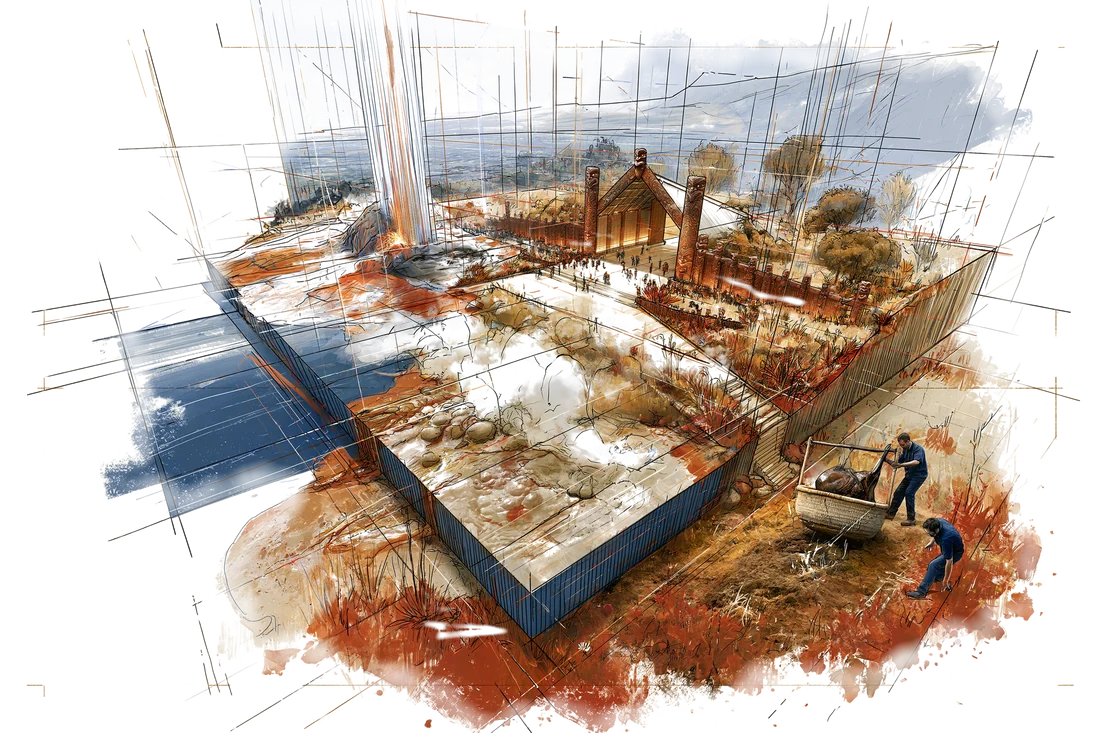
A hāngī is a traditional Māori earth oven. Stones are heated in a fire, placed in a pit, and baskets of meat, kūmara (sweet potato), pumpkin and stuffing are set on top, covered with wet cloth and earth, and left to steam for hours. The result is smoky, tender and very filling. In Rotorua, some hāngī are cooked in natural steam instead of fire.
The haka is a posture dance: chanting, stamping, slapping, fierce facial expressions, eyes wide and tongues out. Many people know it from the All Blacks rugby team, whose best-known haka, Ka Mate, was composed by the chief Te Rauparaha around 1820. But haka are performed for many reasons, including welcomes, funerals, weddings, celebrations and challenges. An evening cultural experience in Rotorua usually includes a pōwhiri (welcome ceremony), songs and haka, and a hāngī dinner.
Tikanga: a few basics
Tikanga means Māori customs, the correct way of doing things. As a guest:
- During a pōwhiri, follow your hosts. Stay quiet during the challenge and speeches, and don't eat or drink until invited.
- The hongi is a greeting in which two people press noses and foreheads, sharing breath. If it's offered, accept it gently; if you're unsure, a handshake is fine.
- Heads are tapu (sacred). Don't touch anyone's head, and don't sit on tables or pillows, which are associated with food and with heads.
- Shoes off before entering a wharenui (meeting house), and ask before taking photos inside.
- "Kia ora" (hello, thank you) is used everywhere and always welcome.
A city built on boiling ground, and a people who have cooked on it for centuries.
罗托鲁瓦是先闻到、后看到的。一股臭鸡蛋味在城里飘来飘去,有的街浓些,有的街淡些,源头是公园里、人家后院里、湖岸边冒出来的蒸汽。本地人早就闻而不觉,游客待上一两天也就习惯了。这是一座直接建在活跃地热田上的城市的味道。同时,这里也是新西兰毛利文化旅游的中心。两段故事,长在同一片土地上。
为什么有味道,为什么冒热气
罗托鲁瓦位于陶波火山带,这条火山与地热活动带从南边的鲁阿佩胡山,一直延伸到丰盛湾里的怀特岛。罗托鲁瓦湖本身就填在一个古老的破火山口里。雨水渗到地底深处,被岩浆加热,再以间歇泉、温泉、沸腾的泥浆和蒸汽的形式回到地面。一路上,水里溶进了各种矿物和气体,尤其是硫化氢,那股味道就是它来的。本地人管这座城叫“硫磺城”(Sulphur City),语气里带点亲昵。
两条实用守则:在地热区一定走标好的步道(地壳可能很薄,底下是滚水);泡温泉前把银首饰摘下来,硫会把它熏黑。
怀奥塔普:调色板
罗托鲁瓦往南约 30 公里的怀奥塔普地热公园(Waiotapu,意为“神圣之水”),是这一带颜色最艳的地热公园。一圈环线步道走一到两个小时,沿途是塌陷的火山口、硫磺染黄的岩架和咕嘟冒泡的水池。
- 香槟池。 公园的核心:一口直径约 65 米、深约 62 米的温泉,是大约 900 年前一次水热喷发炸出来的。水温在 74°C 上下,二氧化碳从水里往上冒,像香槟一样滋滋起泡。池边那圈出名的橙色,来自富含砷、锑化合物的沉积。凉爽的早上,蒸汽会遮住半个池子;晴天下午,颜色最是鲜亮。
- 艺术家调色板。 就在香槟池旁边,一大片浅浅的阶地,被不同的矿物和微生物染出绿、黄、橙、紫的条纹,随水位高低不停变化。
- 樱草台地。 一片浅色、层层叠叠的硅华台地,是富含二氧化硅的泉水一粒一粒堆起来的。
- 泥浆池。 在公园外的进场道路边,免费,一整片灰色泥浆噗噗冒泡。
Te Arawa
罗托鲁瓦是 Te Arawa 的故乡。Te Arawa 是一个部落联盟,祖先是几百年前乘 Te Arawa 号 waka(远洋独木舟)来到这里的那批人。探险者 Ihenga 给湖起名 Rotorua-nui-a-Kahumatamomoe,意思是“Kahumatamomoe 的第二个大湖”。几百年来,Te Arawa 人一直与地热共处:在温泉里煮饭,在暖池里洗浴,靠地热给屋子取暖。
Te Arawa 也是最早和外来游客打交道的毛利人之一。1886 年塔拉威拉火山喷发,毁掉了闻名遐迩的粉白阶地,是法卡雷瓦雷瓦(Whakarewarewa)一带的向导和村落让旅游业撑了下来。直到今天,法卡雷瓦雷瓦仍有人家住在冒汽的喷气孔之间,用温泉池煮饭。隔壁的 Te Puia 有波胡图间歇泉(Pōhutu),南半球最大的活跃间歇泉,一天要喷好多次。
地灶与哈卡
hāngī 是毛利人传统的“地灶”。先把石头在火里烧热,放进坑里,再把一篮篮肉、kūmara(毛利红薯)、南瓜和填馅搁在上面,盖上湿布和泥土,焖上几个钟头。出锅的东西带着烟熏味,软烂,非常顶饱。在罗托鲁瓦,有些 hāngī 干脆不用火,直接用地热蒸汽来焖。
哈卡是一种姿势舞:吟诵、跺脚、拍打身体,面目狰狞,瞪大眼睛,吐出舌头。很多人是从全黑队(All Blacks)橄榄球比赛上认识它的,全黑队最有名的那段哈卡 Ka Mate,是酋长 Te Rauparaha 在 1820 年前后创作的。但跳哈卡的场合远不止比赛:迎客、葬礼、婚礼、庆典、挑战都有。在罗托鲁瓦参加一场晚间文化体验,一般会有 pōwhiri(欢迎仪式)、歌舞和哈卡,最后是一顿 hāngī 晚餐。
Tikanga:几条基本规矩
Tikanga 指毛利人的习俗,也就是“做事的正确方式”。作为客人:
- pōwhiri 仪式上,跟着主人走。挑战和致辞的时候保持安静,主人没请之前不要吃喝。
- 碰鼻礼(hongi) 是两人鼻子和额头相抵、交换气息的问候。对方主动的话,轻轻接受就好;拿不准的话,握手也完全可以。
- 头是 tapu(神圣的)。 不要碰别人的头;也不要坐在桌子或枕头上,这两样一个和食物相关,一个和头相关。
- 进 wharenui(会堂)前要脱鞋,在里面拍照前先问一声。
- “Kia ora”(你好、谢谢)到处都在用,说了总没错。
一座建在滚烫土地上的城,一群在这片土地上做了几百年饭的人。
Where this shows up on the trip行程里对应的日子